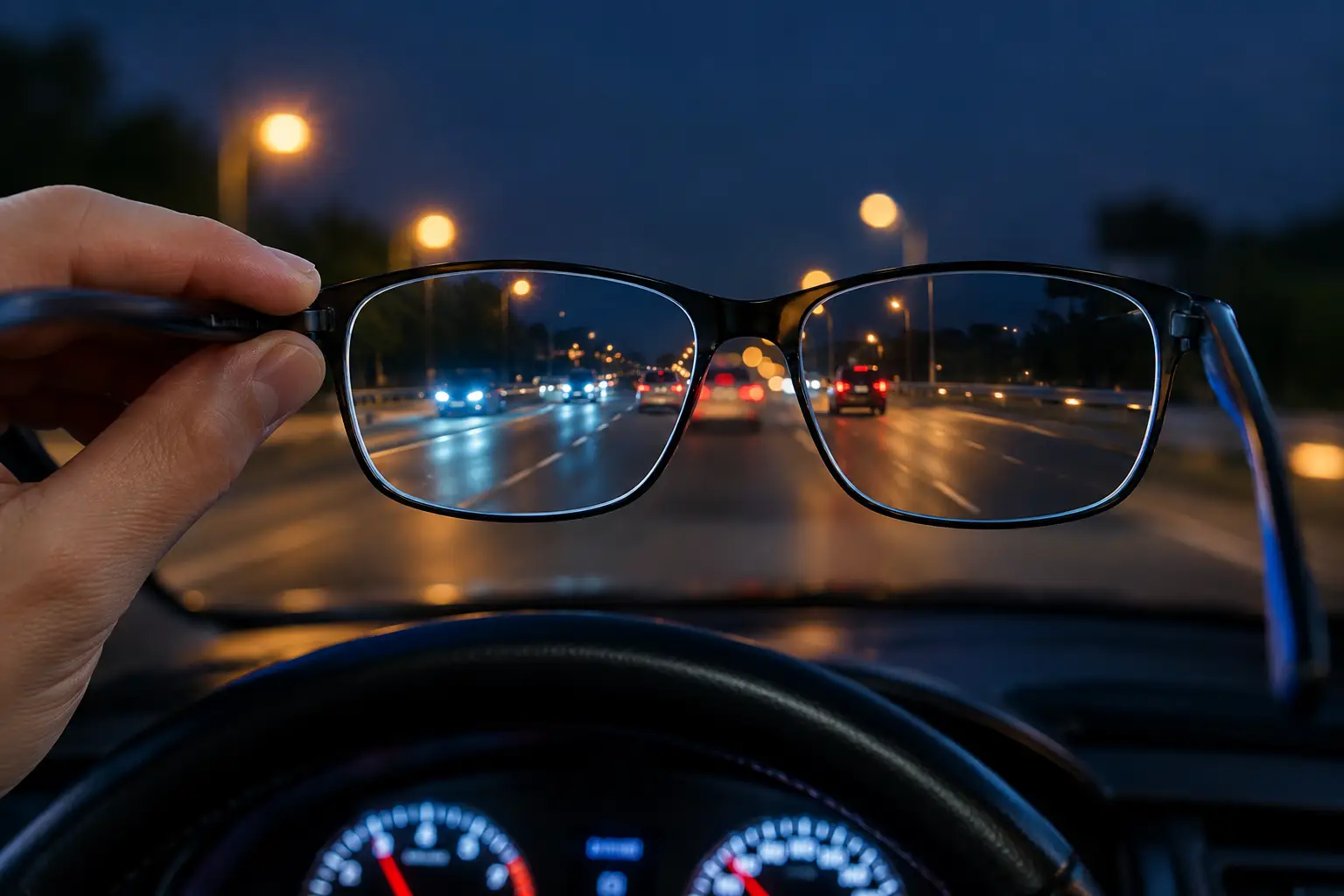
A dark road, wet pavement, and headlights in the opposite lane can turn an ordinary drive into a visual challenge. The best lenses for night driving do not create night vision, but the right prescription, lens design, and anti-reflective coating can meaningfully reduce distracting reflections and help you use the vision you have more comfortably.
If driving after dark has become stressful, do not assume you simply need to tolerate it. Night glare can be related to an outdated prescription, dry eye, early cataract changes, lens scratches, or a frame that is not positioned correctly. A comprehensive eye exam and an optical consultation can identify what is interfering with clear, confident vision.
What Makes Night Driving Harder?
At night, your pupils naturally become larger to let in more light. That can make small prescription errors, uncorrected astigmatism, and optical imperfections more noticeable. Headlights, traffic signals, illuminated signs, and reflections from a wet windshield add another layer of visual demand.
Glare is often the complaint people notice first. It may appear as halos, starbursts, streaks, or a bright haze around headlights. Some glare comes from the environment, but reflections on the front and back surfaces of eyeglass lenses can add to the problem. Lens coatings and a precise prescription matter because they address those avoidable sources of visual noise.
The goal is not a special pair of miracle glasses. It is a pair of clear, well-fitted prescription lenses that supports sharp vision, good contrast, and comfortable use in low light.
Best Lenses for Night Driving Start With an Accurate Prescription
A current prescription is the foundation of any nighttime eyewear recommendation. Even a minor change in nearsightedness, farsightedness, astigmatism, or binocular vision can be more apparent after sunset. If you find yourself squinting at road signs, moving closer to the steering wheel, or avoiding nighttime trips, it is worth having your eyes evaluated rather than buying over-the-counter driving glasses.
Clear Lenses With Premium Anti-Reflective Coating
For most drivers, clear prescription lenses with a high-quality anti-reflective coating are the best choice for night driving. This coating reduces reflections from the lens surfaces, allowing more light to pass through the lens and reducing the distracting reflections you may see from headlights, dashboard lights, and overhead streetlights.
The benefit is not limited to what you see through the lenses. Anti-reflective coatings also make your eyes more visible to the person speaking with you, which can be helpful in everyday life and in professional settings.
Not every anti-reflective coating performs the same way. Higher-quality options are typically more durable, easier to clean, and less likely to show persistent smudges. Ask about a coating that includes scratch resistance and a water- and oil-repellent top layer. Lenses that stay cleaner are easier to see through, especially when driving at night.
Lenses That Correct Astigmatism Precisely
Astigmatism is a common reason headlights may look stretched, streaked, or unusually bright. It occurs when the eye does not focus light evenly, and even a small amount can affect visual quality in dim conditions.
An accurate astigmatism correction can sharpen the edges of road signs and reduce the need to squint. If your glasses are relatively new but night driving still feels uncomfortable, the issue may be how the lenses were measured, centered, or fit in the frame. Accurate pupil measurements and frame positioning are particularly important for stronger prescriptions.
High-Index Lenses for Stronger Prescriptions
High-index lenses can be a good option for people with moderate to strong prescriptions because they are thinner and lighter than standard plastic lenses. A lighter lens can improve comfort, and a thinner profile may look more natural in many frame styles.
There is a trade-off. Higher-index materials can reflect more light without a strong anti-reflective coating. For nighttime driving, pairing high-index lenses with a premium anti-reflective coating is especially important. The right material depends on your prescription, frame selection, visual priorities, and budget.
Progressive Lenses for Drivers Who Need Multifocal Vision
For adults who need help seeing both the road ahead and the dashboard, progressive lenses can be an excellent everyday solution. They provide distance, intermediate, and near vision without the visible line of a bifocal.
However, progressive lenses are not one-size-fits-all. The peripheral areas of any progressive design have some unavoidable distortion, and certain designs provide wider distance or intermediate viewing zones than others. A driver who spends considerable time on highways may have different needs from someone who mainly drives through town or checks navigation screens frequently.
Proper fitting is essential. A frame that sits too low, slides down the nose, or is adjusted poorly can place the progressive zones in the wrong position. During an optical consultation, share how you drive, how often you use a dashboard screen, and whether you struggle with side vision or quick glances between the road and instruments.
Are Yellow Night Driving Glasses a Good Idea?
Yellow-tinted lenses are heavily marketed for night driving, but they are not the best choice for most people. A tint reduces the amount of light reaching your eyes, which is generally not helpful when visibility is already limited. While some people feel a yellow lens changes the appearance of contrast, it does not reliably improve nighttime driving performance.
Clear lenses with the correct prescription and anti-reflective coating are usually the more practical and clinically sound recommendation. The same caution applies to dark sunglasses, even lightly tinted ones. Sunglasses should not be worn for nighttime driving because they reduce available light.
Blue-light-filtering lens options may be useful for some people who spend long hours on digital devices, but they should not be selected with the expectation that they will solve nighttime glare. Glare, dry eye, prescription accuracy, and eye health are more relevant areas to assess.
Lens Care Matters More Than Many Drivers Realize
A quality lens can only perform well when its surface is clear. Fine scratches, fingerprints, skin oils, and a cloudy coating can scatter light and make headlights feel more distracting. If your glasses look hazy even after cleaning, the lenses or coating may be worn and ready for replacement.
Clean lenses with a rinse of lukewarm water, a small amount of lens-safe cleaner, and a clean microfiber cloth. Avoid using paper towels, tissues, or the edge of a shirt, which can leave scratches over time. Keep a microfiber cloth in your vehicle, but clean it regularly so it does not transfer grit back to the lenses.
Your windshield also plays a role. Interior film on the glass can create glare from oncoming traffic, while worn wiper blades can leave streaks that scatter light. Clean eyewear and a clean windshield work together.
When Night Glare Calls for an Eye Exam
New or worsening difficulty driving at night deserves attention, particularly if halos, glare, blur, or light sensitivity are affecting your confidence behind the wheel. These changes can be associated with dry eye disease, cataracts, corneal irregularities, medication effects, or changes in prescription.
Dry eye is easy to overlook. An unstable tear film can make vision fluctuate and cause lights to appear smeared or starburst-like. If your eyes burn, water, feel gritty, or become blurry after screen time, dry eye care may be part of the solution.
An eye exam also helps rule out conditions that should not be addressed by changing glasses alone. At Mountain Eye Care, a comprehensive evaluation can look beyond the prescription to assess the health of the eyes and recommend lenses that fit your daily visual needs.
How to Choose Night Driving Lenses With Confidence
Bring your actual driving concerns to your appointment. Mention whether glare is worse in rain, whether you have trouble reading signs, whether one eye seems blurrier, and whether you wear progressives or contact lenses. Specific examples help your eye care team recommend the right lens material, design, coatings, and frame fit.
For many people, the answer is straightforward: an updated clear prescription with a premium anti-reflective coating in a properly adjusted frame. For others, addressing dry eye, changing a progressive design, or investigating eye health concerns may be the more important next step.
Night driving should not require you to guess at what is ahead. Clear lenses, accurate measurements, and healthy eyes give you the best chance to stay comfortable, alert, and confident when the road gets dark.