Reading a prescription label should not require guesswork. Neither should recognizing a family member across a room, checking the stove, or enjoying a favorite book. A guide to low vision aids starts with a simple point: the right device is not necessarily the strongest one. It is the one that helps a person complete a specific task safely, comfortably, and with as much independence as possible.
Low vision aids can make meaningful daily activities more manageable for people whose vision cannot be fully corrected with standard glasses, contact lenses, medication, or surgery. They do not cure the underlying eye condition or restore vision to normal. What they can do is make better use of the vision that remains.
What Is Low Vision?
Low vision is a level of visual impairment that continues even after conventional vision correction. It may involve reduced sharpness, missing areas in the visual field, poor contrast sensitivity, glare sensitivity, trouble adapting between light and dark, or difficulty seeing fine detail.
Common causes include age-related macular degeneration, glaucoma, diabetic eye disease, cataracts that cannot be fully corrected, inherited retinal conditions, optic nerve damage, and neurological conditions. Two people with the same diagnosis may have very different visual needs. Someone with central vision loss may need help reading faces and print, while someone with peripheral vision loss may need strategies for navigating stairs, crowds, and busy environments.
That is why choosing an aid from a store shelf based on magnification alone often leads to frustration. Low vision care should begin with an assessment of what a person wants and needs to do.
Guide to Low Vision Aids: Start With the Task
A low vision assessment examines more than the eye chart. It considers the eye condition, usable vision, contrast sensitivity, glare, working distance, posture, hand steadiness, and everyday goals. A person who wants to read mail has different needs from someone who wants to watch television, sew, use a computer, or follow signs while traveling.
The clinician may test different magnification levels and device types, then teach the patient how to position the aid and reading material. This training matters. A stronger magnifier has a smaller viewing area and must be held closer to the page. For some patients, that trade-off is worthwhile. For others, a lower-powered device with a wider field of view is more practical.
A good plan often combines several aids rather than relying on one product for every situation.
Optical Aids for Reading and Detail Work
Optical devices use lenses to enlarge print or objects. They are often helpful for reading labels, mail, medication bottles, recipes, hobby materials, price tags, and photographs.
Handheld and Stand Magnifiers
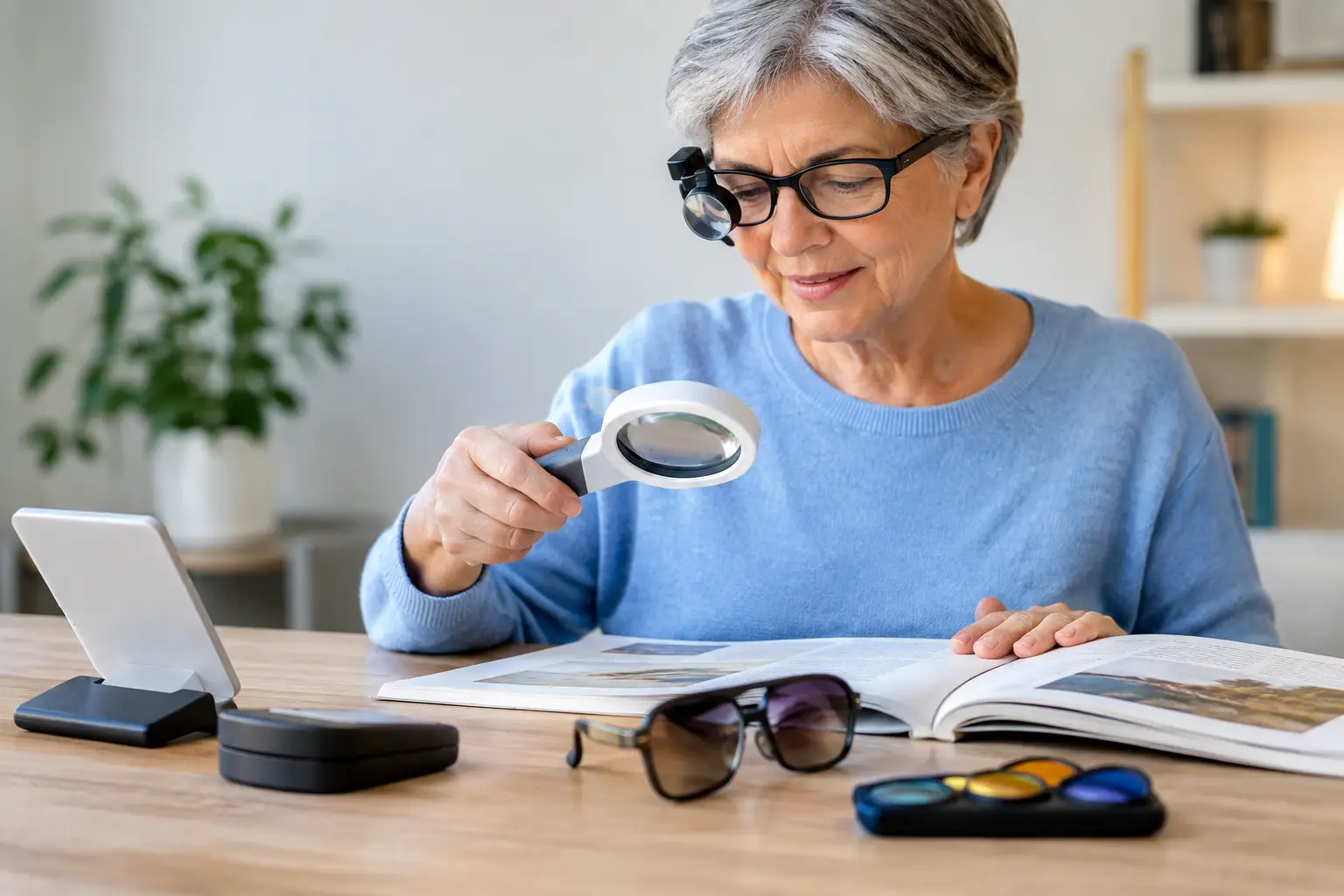
Handheld magnifiers are portable and convenient for short tasks away from home. Some include built-in illumination, which can improve visibility in dim spaces. They require a steady hand and coordinated movement, so they may be less comfortable for extended reading or for people with tremors or arthritis.
Stand magnifiers rest directly on the page and keep the lens at the correct focal distance. This can make them easier to use for longer tasks. However, they are not always ideal for handwriting because the base may block the writing surface.
High-Power Reading Glasses and Microscopes
High-power reading glasses, sometimes called microscopic reading glasses, are designed for close work. They can provide a hands-free option for reading, crafts, or detailed tasks, but the material must be held much closer than with standard readers. Good lighting and proper posture are essential.
For some patients, these glasses are an excellent solution for sustained reading. For others, the close working distance feels uncomfortable or is difficult to maintain. The best choice depends on the task, neck mobility, and how long the device will be used.
Telescopic Aids
Telescopes enlarge distant objects. A handheld telescope may help with street signs, store shelves, presentations, sporting events, or recognizing faces from across a room. Spectacle-mounted telescopes can be useful in select cases, but they require careful fitting and training.
Bioptic telescopes are a specialized option that may support distance tasks for certain patients. Driving with a bioptic device is not appropriate for everyone and is subject to licensing requirements, visual standards, and professional evaluation. It should never be assumed that a device alone makes driving safe.
Electronic Low Vision Aids Offer Flexibility
Electronic magnification has changed how many people read and view details. Video magnifiers use a camera and screen to enlarge text, adjust contrast, change color combinations, and freeze an image. A desktop model may be useful for books, paperwork, and hobbies, while portable electronic magnifiers can be carried to restaurants, stores, and appointments.
Tablets, smartphones, and computers can also be valuable low vision tools. Built-in accessibility features may enlarge text, increase contrast, read content aloud, and allow voice commands. These options can be especially helpful because they support communication, banking, navigation, and access to information in one familiar device.
Electronic aids are not automatically the best choice. They can be more expensive, require charging, and take time to learn. A simple illuminated stand magnifier may be more convenient for reading a short label. The goal is to match the technology to the person, not to choose the most advanced device available.
Lighting, Contrast, and Glare Control Matter
Many people with low vision see better with improved lighting, but brighter is not always better. Poorly directed light can create glare and make vision worse, particularly for people with cataracts, macular degeneration, corneal conditions, or light sensitivity.
Task lighting should be directed onto the page, countertop, or work area without shining into the eyes. Adjustable lamps are useful because the light can be positioned where it is needed. Even, well-distributed lighting in hallways, stairways, kitchens, and bathrooms also supports safer movement around the home.
Contrast is equally practical. A dark cutting board can make pale foods easier to see, while a light plate can help dark foods stand out. Dark tape on the edge of a light stair tread, bold markers on appliance controls, and high-contrast labels on medication containers can reduce daily frustration. These changes are inexpensive, but they can have a significant effect.
Tinted lenses, filters, hats, and clip-on sunwear may help manage glare outdoors or in bright indoor environments. The ideal tint varies by condition and personal comfort. Very dark lenses are not always appropriate indoors because they may reduce useful vision, so professional guidance is worthwhile.
Non-Optical Aids Build Safer Routines
Not every effective low vision aid contains a lens. Large-print calendars, talking clocks, high-contrast watches, bold-line paper, tactile markers, and audio labels can reduce visual demand. A pill organizer with clear, large labels may be easier to manage than small prescription bottles, though medication routines should be reviewed carefully with a pharmacist or health care provider.
Organization also supports independence. Keeping frequently used items in consistent locations reduces the need to search visually. Removing loose rugs, improving stair lighting, and marking the edge of steps can lower fall risk. For patients with reduced peripheral vision or poor contrast sensitivity, these environmental changes may be as valuable as magnification.
When a Low Vision Assessment Is the Right Next Step
An eye examination remains essential when vision changes suddenly, becomes distorted, or declines noticeably. New flashes, floaters, a curtain-like shadow, eye pain, or sudden loss of vision require prompt medical attention rather than a search for stronger magnifiers.
For established vision loss, a low vision assessment can identify practical tools and determine whether updated glasses, filters, magnifiers, electronic devices, or distance aids may help. It can also clarify when referral for rehabilitation services, orientation and mobility training, or occupational therapy would be beneficial.
At Mountain Eye Care, low vision assessments are designed around real-life goals, from reading and cooking to managing technology and seeing more confidently at a distance. The most useful aid is the one a patient will actually use, comfortably and consistently.
Living with reduced vision often means adapting familiar routines, not giving them up. Start with the activity that matters most, whether it is reading a grandchild’s card, preparing a meal, or seeing a favorite program clearly, and build the right support around that goal.