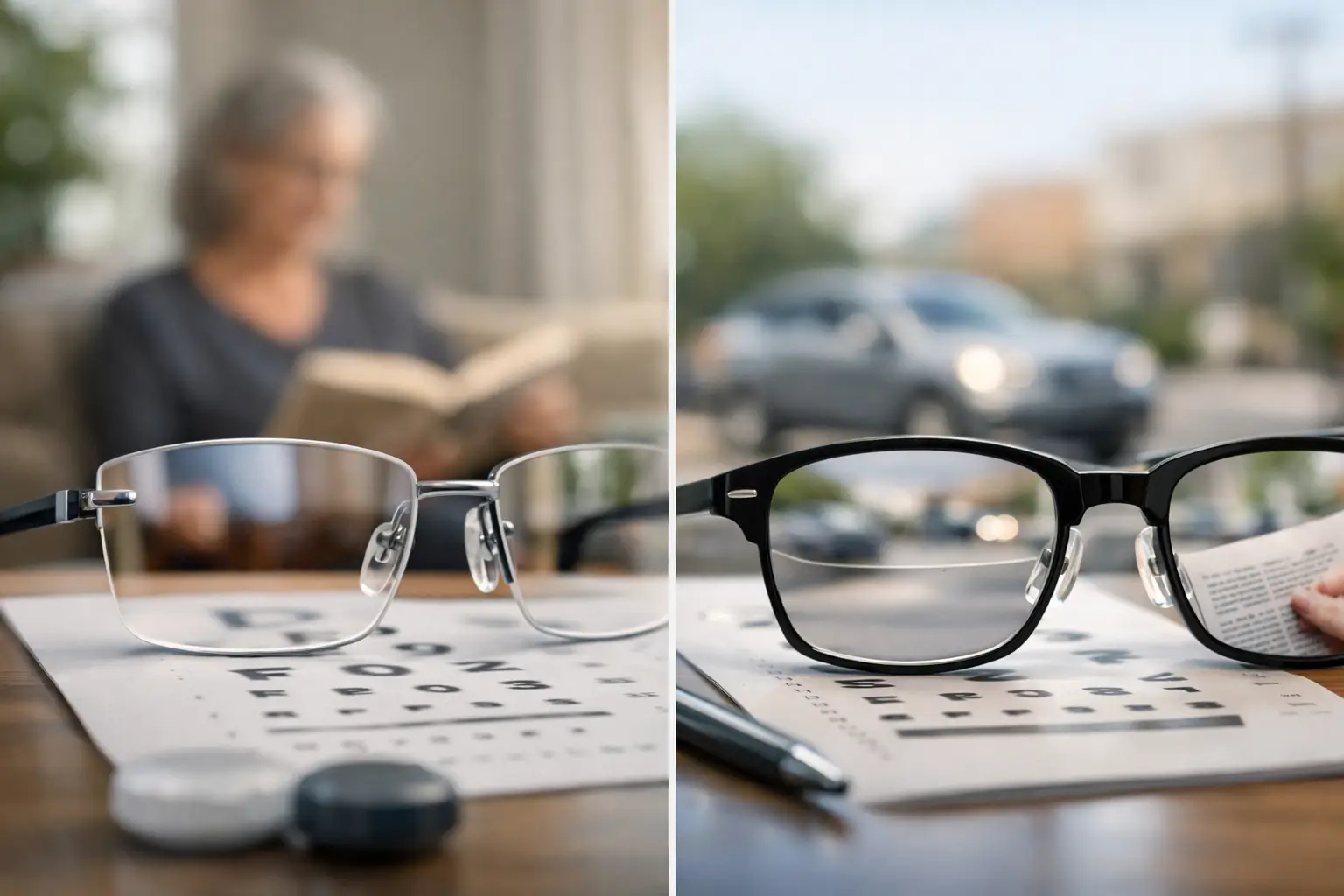
A restaurant menu held at arm’s length, a dashboard that looks slightly soft, and a phone screen that suddenly needs brighter light are familiar signs of presbyopia. This age-related change makes close-up focus more difficult, often beginning in the 40s. When comparing progressive vs bifocal lenses, the right choice is not simply about age or price. It depends on how you use your eyes throughout the day, the strength of your prescription, your frame choice, and how much adjustment you are comfortable with.
Both options can provide distance and reading correction in one pair of glasses. The difference is how they deliver those prescriptions and how naturally they support the tasks between them.
How Bifocal Lenses Work
Bifocal lenses contain two distinct prescription areas. The upper portion corrects distance vision for tasks such as driving, watching television, or recognizing faces across a room. A visible segment near the bottom of the lens provides stronger magnification for reading, medications, knitting, or using a phone.
The line in a bifocal lens is functional. It marks a clear change from the distance prescription to the near prescription. When you look down through the lower segment, close objects become clear quickly. There is no gradual transition and typically little uncertainty about where to look for reading vision.
This design has served patients well for generations. It remains a practical option for people who primarily need clear distance vision and occasional close-up help. Bifocals can also be a sensible choice when straightforward function, quick adaptation, or budget is the priority.
However, standard bifocals do not correct the middle range between distance and reading. A computer monitor, grocery shelf, vehicle controls, or a conversation across a desk may fall into that uncorrected zone. Some people compensate by lifting or lowering their chin, moving closer, or taking off their glasses for certain tasks.
How Progressive Lenses Work
Progressive lenses provide a gradual change in prescription from the top to the bottom of the lens. Distance vision is positioned near the top, intermediate vision occupies the central corridor, and reading vision is found near the bottom. There is no visible line.
That intermediate area is the key difference. It supports the arm’s-length vision needed for desktop screens, cooking, shopping, viewing a car dashboard, and talking with someone across a table. For many people, progressives more closely match the way vision is used in real life because they offer a continuous range rather than two separate viewing zones.
Modern progressive lens designs are highly customized. Lens manufacturers can account for prescription strength, frame measurements, the angle at which the frame sits, and how far the lenses sit from the eyes. Premium designs may offer wider viewing areas and less peripheral distortion than basic designs, but they still require accurate measurements and proper fitting.
Progressives are not automatically the best answer for everyone. They involve a learning period, and the lens design may not suit every task or every work environment. The best lens is the one that gives you dependable vision for your actual routine.
Progressive vs Bifocal Lenses: Key Differences
The most noticeable difference is the transition between prescriptions. Bifocals have an abrupt change that is visible in the lens. Progressives offer a smooth, line-free transition across distance, intermediate, and near vision.
This affects appearance as well as function. Many patients prefer progressives because they look like single-vision glasses. Others appreciate the immediate, clearly defined reading zone in a bifocal and do not mind the visible segment.
Adaptation is another important consideration. Most people can adjust to bifocals quickly because the two zones are easy to identify. The trade-off is the image jump when the eyes move from the distance portion into the reading segment. This can be especially noticeable when walking downstairs or looking from far away to close up.
Progressive lenses may take several days to a few weeks to feel natural. Early on, some wearers notice mild peripheral blur or need to turn their head more directly toward what they want to see. Consistent wear is usually the best way to adapt. Switching back and forth between progressives and an older pair can prolong the adjustment period.
Cost also varies. Conventional bifocals are often less expensive because their design is simpler. Progressive lenses typically cost more, particularly when paired with premium lens materials, anti-reflective coating, photochromic technology, or personalized measurements. The added investment can be worthwhile when intermediate vision is a major part of the day.
Who May Prefer Bifocal Lenses?
Bifocals may be a strong fit for patients who have a clear distance prescription and need help mainly with close reading. They can work well for someone who reads books, checks a phone, completes paperwork, or does close hobbies but does not spend long periods at a computer.
They may also suit patients who want a simple lens design, are concerned about adapting to progressive corridors, or need a lower-cost multifocal option. In some cases, a bifocal’s defined near segment is helpful for a person who wants a predictable reading area without searching for the clearest point in the lens.
A bifocal may be less convenient if you regularly work on dual monitors, glance at a dashboard while driving, or need comfortable vision across multiple distances. The missing intermediate range often becomes more noticeable as screen use increases.
Who May Prefer Progressive Lenses?
Progressives are often the better everyday choice for people who move frequently between distance, screen, and reading tasks. They can be especially useful for teachers, office professionals, active parents, shoppers, drivers, and anyone who wants one pair of glasses for most daily activities.
They are also appealing for patients who prefer a more cosmetic, line-free lens. A well-fitted progressive can offer clear, natural vision across a wide range of distances without the obvious look of a bifocal segment.
Still, lifestyle matters more than appearance alone. A patient who spends eight hours a day working at a desktop may benefit more from dedicated computer glasses than from relying only on general-purpose progressives. A mechanic, musician, dental professional, or person doing detailed bench work may need an occupational lens designed for a particular working distance. General progressives are versatile, but no single design is perfect for every specialized task.
Frame Choice and Measurements Matter
A multifocal lens is only as good as its fitting. The position of the optical centers, the height of the reading area, and the frame’s shape all affect comfort. Even an excellent progressive design can feel wrong when measurements are inaccurate or a frame slips down the nose.
Very shallow frames can limit the available vertical space for a progressive corridor. They can still work in some cases, but the lens design must be selected carefully. Larger frames may provide more room for distance, intermediate, and reading zones, though the final choice should also feel comfortable and suit your prescription.
Your optician should take precise measurements while you are wearing the selected frame, not rely solely on a number from a prior pair. Frame adjustment is equally important. Glasses that sit crooked, slide down, or sit too far from the eyes can change how you use the lens zones.
Tips for Adapting to Progressive Lenses
If you choose progressives, wear them consistently from the start unless your eye doctor gives different instructions. Point your nose toward the object you want to view instead of relying only on eye movement into the lens edges. For reading, lower your eyes naturally and hold materials at a comfortable distance.
When using stairs or curbs during the first few days, look through the upper distance portion of the lens and move more deliberately. Avoid tilting your head into an awkward position to force clarity. If your computer screen is not clear, the screen height, working distance, prescription, or lens design may need adjustment.
Do not assume discomfort means you have to give up immediately. A proper follow-up can identify whether the issue is normal adaptation, frame position, measurement accuracy, prescription change, or a lens design that does not match your visual demands.
Start With Your Everyday Vision Needs
The decision between progressive and bifocal lenses should begin with an eye exam and an honest conversation about your routine. Bring up how often you drive, use screens, read, work with your hands, exercise, and switch between tasks. These details help your eye care team recommend a lens that supports clear vision without unnecessary compromise.
At Mountain Eye Care, patients can explore multifocal options with guidance from an experienced eye care and optical team. The goal is not to push one lens type for everyone. It is to fit you with glasses that make reading, working, driving, and daily life feel more comfortable. If your current multifocal glasses are causing strain, blur, or awkward head posture, schedule an evaluation and bring them with you. Small fitting changes can make a meaningful difference.