
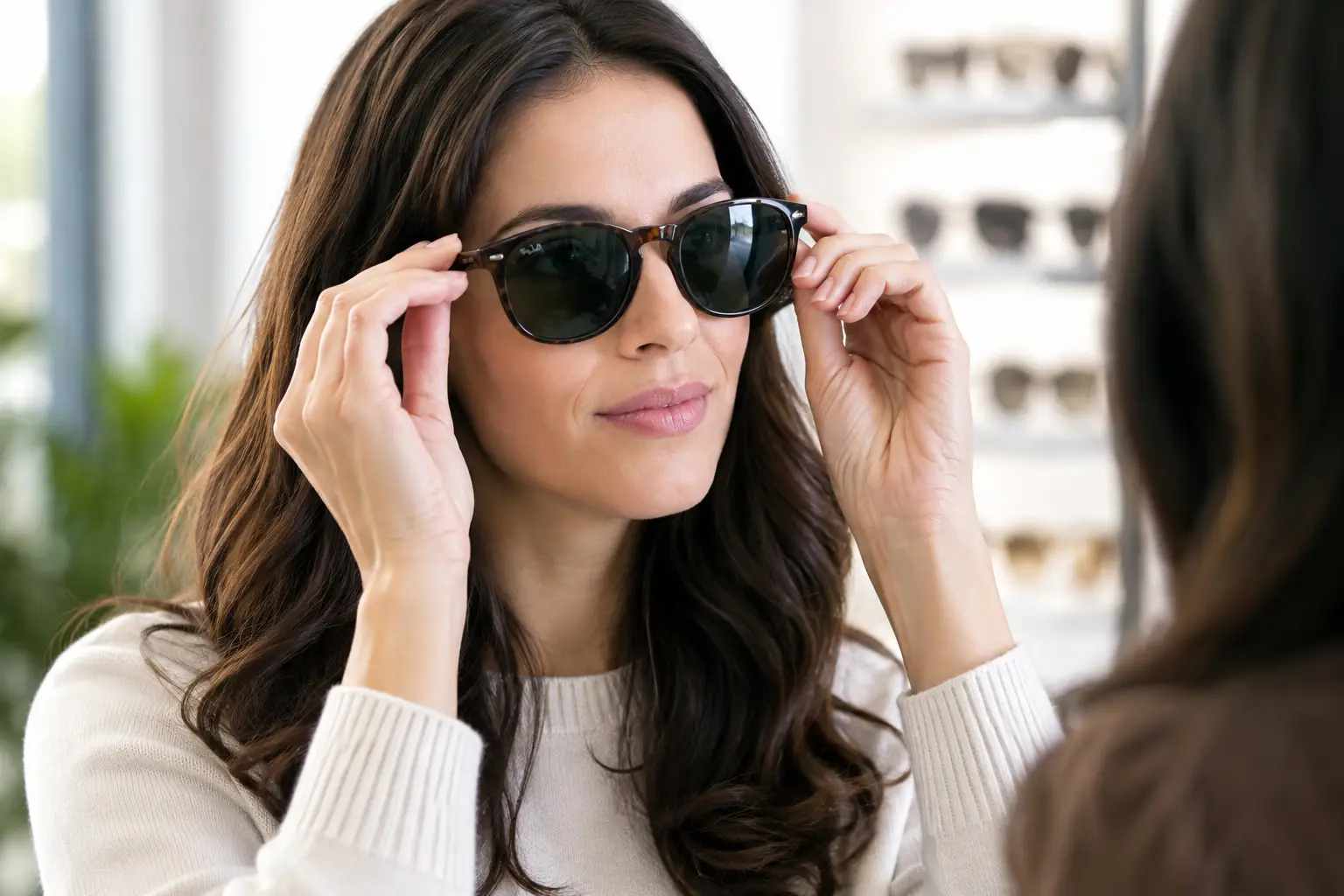
A bright day should not force you to choose between seeing clearly and protecting your eyes. Knowing how to choose prescription sunglasses starts with more than finding a frame you like. The right pair should match your prescription, provide dependable UV protection, fit securely, and work for the places you spend time – behind the wheel, on the water, at a game, or walking through town.
Prescription sunglasses are a practical part of everyday eye care. They reduce glare and squinting while helping shield your eyes from ultraviolet exposure. With the right lenses and fit, they can be just as essential as your regular glasses.
Start with a current prescription and eye exam
Your sunglasses can only perform as well as the prescription in their lenses. If your vision has changed, an older prescription may leave you with blurred distance vision, eyestrain, or difficulty adjusting to different light conditions. A comprehensive eye exam also gives your eye doctor an opportunity to assess eye health, not simply update the numbers on your prescription.
This matters especially if you have diabetes, cataracts, dry eye symptoms, a history of eye disease, or increasing trouble with glare. Strong glare sensitivity can be related to ordinary bright-light discomfort, but it can also deserve a closer clinical conversation. Children and teens need current prescriptions as well, particularly when they spend significant time outdoors.
Bring your everyday glasses to your optical appointment if you wear them. They give the optician useful information about your preferred frame size, lens position, and what has or has not worked for you before.
How to choose prescription sunglasses for your routine
The best sunglasses for driving may not be the best choice for cycling, golf, or an afternoon at the beach. Before focusing on frame color or brand, consider when you will wear them most.
For regular errands, commuting, and social wear, a versatile frame with a comfortable tint and standard impact-resistant lenses may be all you need. If driving is a major part of your day, glare control and clear contrast are often priorities. Outdoor workers, anglers, boaters, and skiers may benefit from lenses designed to manage intense reflected light.
Sports require a more specific approach. Look for a secure fit, durable lens material, and a frame that stays stable when you move. A wrap-style frame can block more peripheral light and wind, but its curve may require specialized lens design to keep vision sharp. It is always worth confirming that your prescription can be made accurately in the frame you choose.
Think about whether you need to read outdoors, too. Progressive sunglasses can provide distance, intermediate, and near vision in one pair, which is helpful for checking a phone, dashboard, scorecard, or menu without swapping glasses. They do involve an adjustment period for some wearers and may have design limits in very small or highly curved frames. A dedicated distance pair may be simpler if you mainly need sunglasses for driving or sports.
Make UV protection non-negotiable
Every pair of prescription sunglasses should provide 100% UVA and UVB protection. UV protection is not determined by how dark a lens looks. A very dark lens without proper UV filtering can be a poor choice because it causes the pupil to open wider while ultraviolet light still reaches the eye.
Look for lenses that clearly state 100% UV protection or UV400 protection. Large lenses and well-fitting frames can provide additional coverage around the eyes, reducing exposure from the sides and top of the frame. This can be particularly useful near water, snow, sand, or pavement, where light reflects upward.
UV protection is a long-term health consideration. Regular exposure may contribute to conditions affecting the eye and the delicate skin around it. Sunglasses are not only a summer accessory. They are useful throughout the year, including on bright winter days.
Choose lens material and coatings with purpose
Lens material affects comfort, durability, and optical performance. Standard plastic lenses are a common everyday option, while polycarbonate and Trivex lenses are lightweight and impact resistant. These materials are often a practical choice for children, active adults, and people who want a durable pair for regular outdoor use.
If you have a stronger prescription, high-index lenses may help reduce thickness and weight. The final result depends on both your prescription and the frame shape. A smaller frame often helps keep lenses thinner at the edges for nearsighted prescriptions, while proper lens sizing also matters for farsighted prescriptions.
A few lens enhancements can make a meaningful difference:
- Polarization reduces reflected glare from flat surfaces such as roads, water, snow, and vehicle hoods. It is popular for driving and outdoor recreation, though some digital displays may appear darker or harder to read at certain angles.
- Backside anti-reflective coating reduces reflections bouncing from the rear surface of sunglass lenses into your eyes. It can improve comfort when light comes from behind or beside you.
- Scratch-resistant coating helps lenses hold up better to everyday wear, but it does not make them scratch-proof. A protective case and proper cleaning still matter.
- Mirror coatings can reduce the amount of visible light reaching the eye and add a distinctive appearance. They are most useful for very bright environments, but should be selected alongside the right base tint and UV protection.
Photochromic lenses darken in sunlight and can be convenient for people who move frequently between indoors and outdoors. However, many photochromic lenses do not darken as much inside a car because windshields filter a portion of the UV light that activates them. For frequent driving, dedicated prescription sunglasses often provide more reliable comfort.
Select a lens tint based on what you see best
Lens color is partly personal preference, but it can affect contrast and comfort. Gray tints offer neutral color perception and are a dependable all-purpose option. Brown or amber tints may enhance contrast, which some people prefer for driving, golf, or variable outdoor conditions.
Green tints can balance contrast and color perception, while rose or copper tints may feel comfortable in changing light. Very dark lenses are not automatically better. The right tint is dark enough to reduce discomfort without making shaded areas, curbs, steps, or dashboard details difficult to see.
For light-sensitive eyes, the solution may be a carefully selected tint, polarization, a larger frame, or a combination of all three. Your optician can help you compare options in person rather than relying on lens color alone.
Prioritize fit, coverage, and prescription accuracy
A stylish frame that slides down your nose or pinches behind your ears will not become a favorite pair. Sunglasses should rest comfortably on the nose, sit level on the face, and provide enough coverage without touching your cheeks or eyelashes. The temples should feel secure without creating pressure points.
Fit also affects vision. The optical center of each lens must align accurately with your eyes. This is particularly important for progressive lenses, stronger prescriptions, prism prescriptions, and wrap frames. Measurements such as pupil distance and fitting height help ensure you are looking through the intended portion of the lens.
Do not assume every frame can accommodate every prescription. Highly curved wraps, oversized frames, drilled rimless styles, and some thin fashion frames can present limitations depending on lens power. A knowledgeable optical team can recommend frames that support your prescription instead of asking you to compromise on clarity.
At Mountain Eye Care, patients can pair a current eye exam with personalized frame and lens guidance, making it easier to choose sunglasses that support both everyday comfort and long-term eye health.
Do not overlook prescription sunglasses for children
Children spend substantial time outdoors, and their eyes need UV protection too. A good pair should have 100% UVA and UVB protection, durable impact-resistant lenses, and a fit that stays in place during play. Wraparound coverage and flexible, comfortable frames can be especially useful for active children.
Let children participate in choosing the frame when possible. A pair they like is far more likely to be worn consistently. For a child with myopia or another changing prescription, regular eye exams help keep both vision correction and sun protection current.
Know when one pair is enough and when it is not
For many people, one well-made pair of prescription sunglasses handles most outdoor needs. Others benefit from two pairs: a polarized everyday or driving pair and a sport-specific pair with a more secure frame. If you wear progressives, you might choose progressive sunglasses for daily use and a single-vision pair for a particular activity where a wider distance viewing area matters most.
The right decision depends on your prescription, lifestyle, and visual demands – not on a one-size-fits-all set of features. Try frames on, discuss how you use your eyes outdoors, and ask to compare lens options under real lighting when possible. A pair that feels natural from the first sunny drive is the pair you will reach for often.