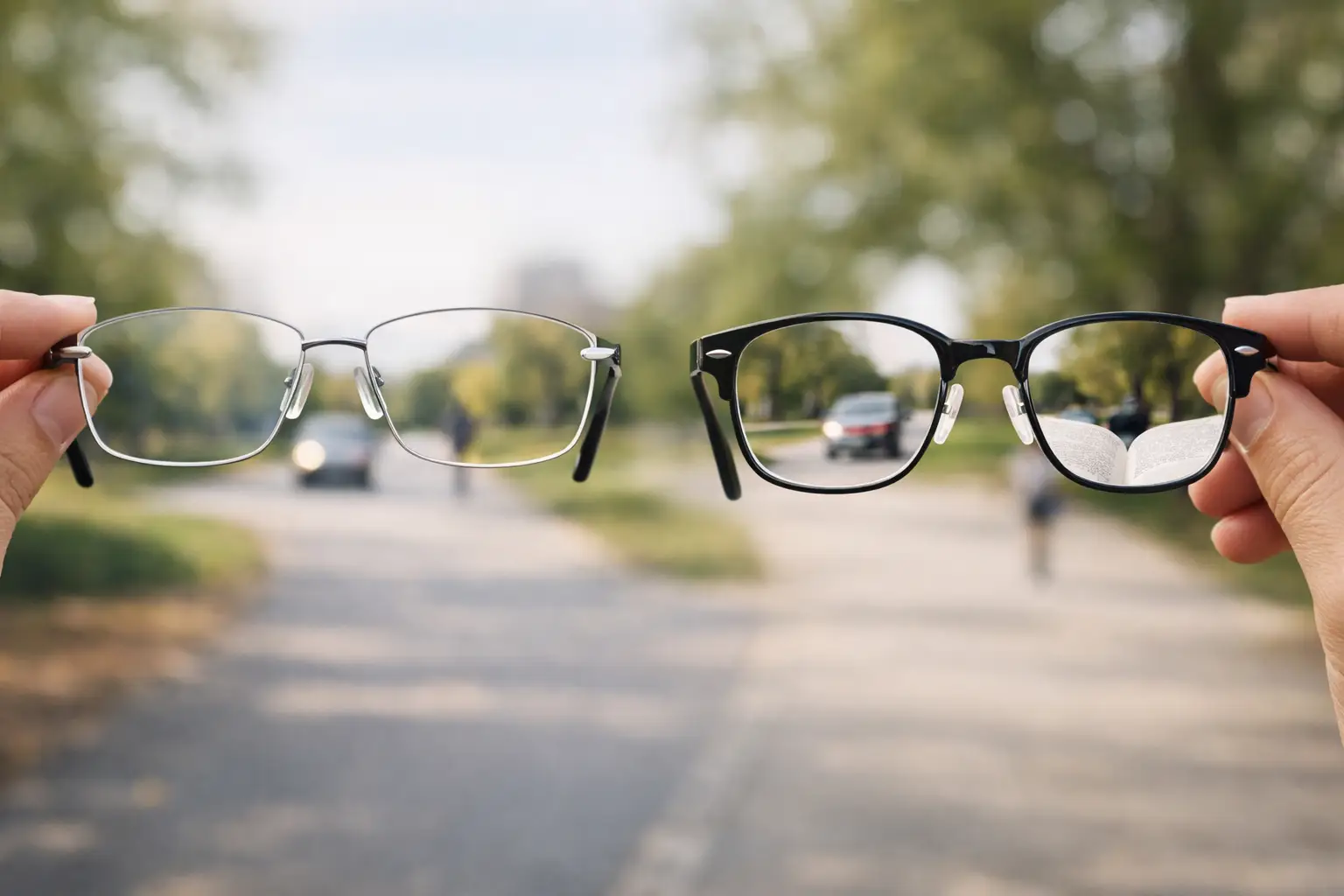
The difference between progressive lenses vs bifocals becomes very real the first time you look down to read a text, then up to find a street sign or speak with someone across the room. Both lens types can correct more than one viewing distance in a single pair of glasses. The better choice depends on your prescription, daily routines, comfort needs, and how much time you are willing to spend adapting to a new lens design.
For many adults, multifocal glasses become necessary when presbyopia begins to affect near vision. This common age-related change makes small print, phone screens, menus, and close work harder to see clearly. A comprehensive eye exam is the right place to confirm what is changing in your vision and discuss lens options that support the way you actually live.
Progressive Lenses vs Bifocals: The Main Difference
Bifocals have two distinct prescription areas: one for distance viewing and one for reading or other close work. A visible line separates the two zones. When you need to read, you look through the lower portion of the lens. When you look ahead, you use the upper distance portion.
Progressive lenses provide a gradual change in prescription from the top of the lens to the bottom. Distance vision is at the top, intermediate vision is generally through the middle, and near vision is at the bottom. There is no visible line, which gives the lens a more natural appearance and allows for more viewing distances.
That design difference affects more than appearance. It changes how you use your eyes, move your head, and adjust to your glasses throughout the day.
Why Some Patients Prefer Progressive Lenses
Progressive lenses are often a strong choice for people who regularly switch between far, middle, and near tasks. Think about a normal day: driving, checking a dashboard, working at a computer, looking at a coworker, reading a message, and preparing dinner. A progressive lens can support all of those distances without changing glasses.
The intermediate zone is a major advantage. Traditional bifocals typically offer distance and near correction, but they do not provide a dedicated computer-distance area. For office work, cooking, shopping, and other arm’s-length activities, that missing range can matter.
Many patients also prefer the cosmetic look of progressives. Without a line across the lens, they look like standard single-vision glasses. This may be especially appealing to first-time multifocal wearers who want an all-purpose pair without an obvious bifocal segment.
However, progressive lenses require an adjustment period for some people. The clearest viewing areas are positioned in specific parts of the lens, so you may need to point your nose toward what you want to see. Peripheral areas can feel slightly distorted at first, especially when walking downstairs, turning quickly, or scanning store shelves. Most people adapt within days or a few weeks, but adaptation is personal.
Lens quality, frame fit, and accurate measurements make a meaningful difference. A progressive lens must be carefully aligned with your eyes and chosen in a frame that provides enough vertical space for the lens design. Premium lens options can also offer wider fields of view and more comfortable vision for demanding tasks.
When Bifocals May Be the Better Choice
Bifocals remain a practical and effective option. They offer a clear, defined reading area that some patients find easy to use immediately. Because the near segment is distinct, there is less guesswork about where to look for close work.
For someone who primarily needs help with distance vision and reading, a bifocal may provide exactly what is needed. They can work well for reading labels, mail, books, medication instructions, and other close tasks, particularly when intermediate computer use is limited.
Bifocals may also be easier for patients who have tried progressive lenses and did not adapt comfortably. Motion sensitivity, balance concerns, certain visual conditions, or a strong preference for a stable near zone can make a lined bifocal the more comfortable choice. A visible line is not a drawback for everyone. For some wearers, it is a familiar feature that makes the lens more predictable.
Cost can be another consideration. Bifocals are often less expensive than premium progressive lens designs, although final pricing depends on prescription complexity, lens material, coatings, and frame choice. The least expensive option is not always the best value if it does not support your most common activities, but budget should be part of an open discussion.
How Your Daily Routine Should Guide the Decision
The right multifocal lens is not determined by age alone. It is determined by what your eyes need to do.
If you drive frequently, use a computer for several hours a day, move between conversations and screens, or prefer one pair of glasses for most activities, progressives are often worth considering. They provide the flexibility that modern routines demand, particularly when you need clear intermediate vision as often as you need reading vision.
If your visual needs are simpler, bifocals may be a smart fit. A person who wears glasses mainly for driving and reading may not need the added range of a progressive design. Similarly, someone who has a dedicated pair of computer glasses or reading glasses may prefer the straightforward function of a bifocal in their everyday pair.
Occupational needs deserve special attention. A mechanic looking down at tools, a teacher moving between students and a whiteboard, a musician reading sheet music, or a caregiver monitoring both near and far tasks may benefit from a lens tailored to those specific working distances. In some cases, an occupational progressive or computer lens is better than either a standard progressive or bifocal.
What to Expect During the Adjustment Period
If you choose progressive lenses, give yourself a fair opportunity to adapt. Wear them consistently rather than switching back and forth to older glasses. Turn your head toward objects instead of relying only on eye movement, and take extra care on stairs and curbs during the first few days.
A proper fitting is essential. The optical center, segment height, frame position, and how the frame sits on your nose all affect performance. Even a well-made lens can feel wrong if it is not positioned correctly. If your glasses are uncomfortable or your vision is not clear after an appropriate adjustment period, return for an assessment. A fit adjustment or measurement review may resolve the issue.
Bifocals usually involve less adaptation, but they also require awareness. Looking through the lower segment while walking can make the floor appear closer or blur the distance ahead. New wearers should still take time to learn where each viewing zone is located.
Lens Features That Can Improve Either Option
Whether you select bifocals or progressives, the lens itself is only part of the decision. Anti-reflective coating can reduce distracting reflections and improve the appearance of your lenses. Scratch-resistant treatments help protect lenses from everyday wear. Photochromic lenses may be useful for people who move often between indoor and outdoor environments, while polarized prescription sunglasses can improve comfort around glare.
High-index materials can make stronger prescriptions thinner and lighter, which may improve appearance and comfort. Your optometrist and optical team can help match these options to your prescription and priorities without adding features you do not need.
A Personalized Fit Matters More Than a Trend
Progressive lenses are not automatically better than bifocals, and bifocals are not outdated simply because they have a visible line. Each design solves a different problem. The best lens is the one that gives you dependable, comfortable vision for the tasks that fill your day.
At Mountain Eye Care, the conversation starts with your eye health, prescription, work habits, hobbies, and past experience with glasses. Bring up any concerns about screen time, driving, stairs, balance, or adapting to new lenses. The right recommendation should feel practical, not pressured.
Clear vision should make your day easier. A careful eye exam and precise eyewear fitting can help you choose a lens design that lets you focus less on your glasses and more on what is in front of you.