
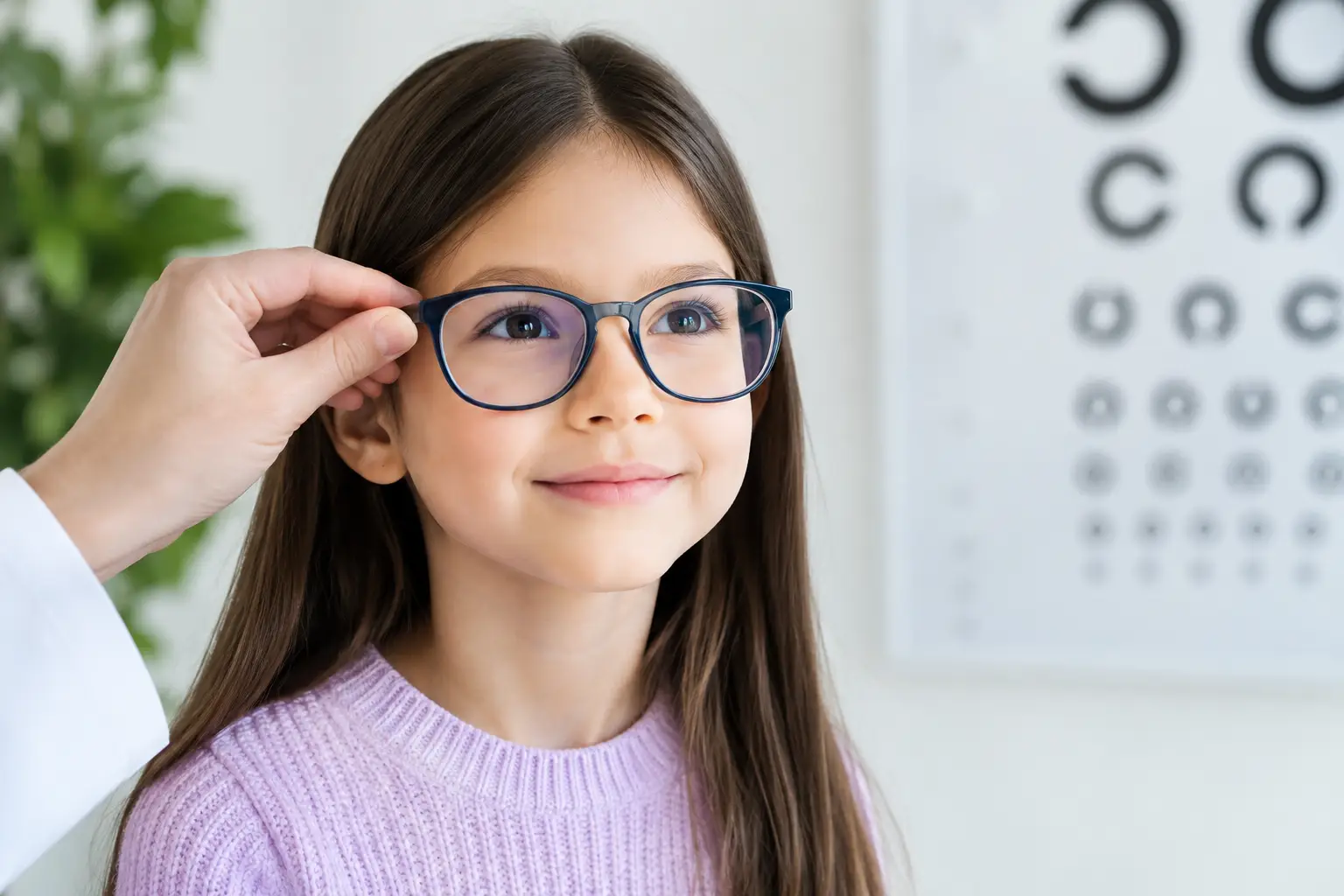
A child who needs a stronger glasses prescription each year is not simply “outgrowing” their eyewear. Myopia, or nearsightedness, often progresses because the eye is growing longer from front to back. Understanding how myopia control lenses work can help parents make an informed decision when their child’s distance vision changes and their prescription keeps increasing.
Standard glasses and contact lenses sharpen blurry distance vision. Myopia control lenses do that too, but they are designed with an additional goal: to slow the eye growth associated with worsening myopia. They are not a cure, and they do not eliminate the need for regular eye care. For many children, however, they can be an effective part of a personalized plan to manage progression.
Why myopia progression deserves attention
Myopia occurs when light focuses in front of the retina rather than directly on it. This usually happens because the eyeball has become too long. A child with myopia may squint to see the board at school, sit close to screens, or have trouble recognizing faces and signs at a distance.
A stronger prescription can be inconvenient, but the concern goes beyond thicker lenses or more frequent glasses updates. Higher levels of myopia are associated with a greater lifetime risk of certain eye-health conditions, including retinal detachment, glaucoma, myopic macular degeneration, and cataracts. Slowing progression while a child is still growing may reduce the final degree of myopia they reach.
Myopia commonly begins during the school years, although it can start earlier. Progression is often fastest in younger children, which is why early exams and consistent monitoring matter. A child’s genetics, visual habits, time outdoors, and age can all play a role. There is no single cause, and there is no one-size-fits-all treatment.
How myopia control lenses work inside the eye
The central area of a myopia control lens provides the clear vision correction a child needs for school, sports, and everyday activities. Around that central zone, the lens uses a carefully designed treatment area to change how light is focused in the peripheral retina.
This is sometimes called peripheral defocus. With ordinary single-vision lenses, the image may be clear in the center while light at the edges of the retina focuses in a way that can encourage the eye to keep lengthening. Myopia control designs aim to create a different optical signal in the peripheral retina – one associated with slowing that excessive eye growth.
The lens does not physically squeeze the eye or make it shorter. Instead, it changes the pattern of light reaching the retina. The retina sends signals that influence how the eye grows, especially during childhood. By delivering clear central vision while managing peripheral focus, these lenses can help guide growth in a more favorable direction.
Researchers are still studying every detail of this process, but the clinical goal is straightforward: correct vision clearly today while reducing the rate at which the prescription may increase over time.
The main types of myopia control lenses
Myopia management can involve specially designed eyeglass lenses, soft multifocal contact lenses, or overnight orthokeratology lenses. The right choice depends on the child’s prescription, age, eye health, daily routine, and ability to follow care instructions.
Myopia control eyeglass lenses
These lenses look much like regular glasses. They have a clear central correction zone and a surrounding pattern of small lens elements or treatment zones. They are often a practical starting point for younger children or for families who prefer glasses over contact lenses.
Eyeglass lenses are easy to wear, do not require handling directly on the eye, and can be a comfortable option for full-time use. Their effectiveness depends in part on consistent wear. A child who only wears the glasses for the classroom but not during the rest of the day may not receive the same benefit as a child who follows the prescribed schedule.
Soft multifocal contact lenses
Soft myopia control contact lenses are worn during the day. Like specialized eyeglasses, they correct central vision while creating a treatment effect in the peripheral retina. Some children and teens prefer them for sports, active play, or appearance.
Contact lenses require maturity and reliable hygiene. Hands must be washed before handling lenses, lenses must be cleaned or replaced as directed, and sleeping in a daytime lens should only happen if the eye doctor has specifically prescribed it. When children and parents are ready for the responsibility, contact lenses can offer excellent vision and an effective myopia management option.
Orthokeratology lenses
Orthokeratology, often called ortho-k, uses custom rigid lenses worn overnight. While the child sleeps, the lenses temporarily reshape the front surface of the eye. The lenses are removed in the morning, allowing many patients to see clearly throughout the day without glasses or daytime contacts.
Ortho-k can be appealing for children involved in athletics or those who strongly dislike daytime eyewear. It also requires careful cleaning, follow-up visits, and strict adherence to the prescribed schedule. Not every eye shape or prescription is suitable, so a detailed contact lens evaluation is essential.
What results can families realistically expect?
Myopia control lenses are intended to slow progression, not stop it with certainty. Some children respond very well, while others continue to progress and may need adjustments to their treatment plan. In clinical studies, different lens designs have often shown meaningful reductions in myopia progression compared with standard correction, but results vary across studies and patients.
Several factors can influence the outcome. A younger child with rapidly progressing myopia may need closer follow-up than an older teen with a stable prescription. Family history matters too. A child with two highly myopic parents may have a higher risk of progression, even with excellent treatment adherence.
The most useful measure is not whether a prescription changes at all. It is whether progression is slower than it would likely have been without treatment. Your eye doctor will track refraction, visual acuity, and often axial length, which measures the length of the eye itself. This creates a clearer picture than a glasses prescription alone.
Lenses are one part of a broader plan
A strong myopia management plan combines appropriate lenses with regular exams and practical habits. More time outdoors has been associated with a lower risk of myopia developing and may support overall visual health. Outdoor time does not replace treatment for a child whose myopia is already progressing, but it is a worthwhile part of a balanced routine.
Near work should also be approached thoughtfully. Reading, homework, and screens are normal parts of school and family life. The goal is not to ban them. Encourage children to use good lighting, keep reading material at a comfortable distance, and take regular visual breaks from close work.
Parents should also know that a child can see clearly through their lenses while myopia continues to progress. Clear vision is necessary, but it is not proof that the condition is stable. Follow-up visits allow the doctor to identify changes early and determine whether the current lens design is doing enough.
When should your child be evaluated?
Schedule an eye exam if your child is squinting, reporting headaches, moving closer to the television, struggling to see the board, or receiving frequent prescription changes. An evaluation is also worthwhile when there is a strong family history of myopia, even if your child has not noticed obvious symptoms.
At Mountain Eye Care, myopia management recommendations are based on a child’s complete eye exam, prescription history, lifestyle, and eye health. The best lens is not necessarily the newest option or the one another family uses. It is the option your child can wear consistently, safely, and comfortably.
A timely exam gives your family something more valuable than a stronger prescription: a clear plan for protecting your child’s vision as their eyes continue to grow.