A street sign that stays blurry until you are almost underneath it. Faces that are hard to recognize across a room. A classroom board, transit display, or store aisle sign that requires guesswork. Patients who ask, “what are bioptic telescopes?” are often looking for a practical way to regain access to those distance details without giving up their everyday glasses.
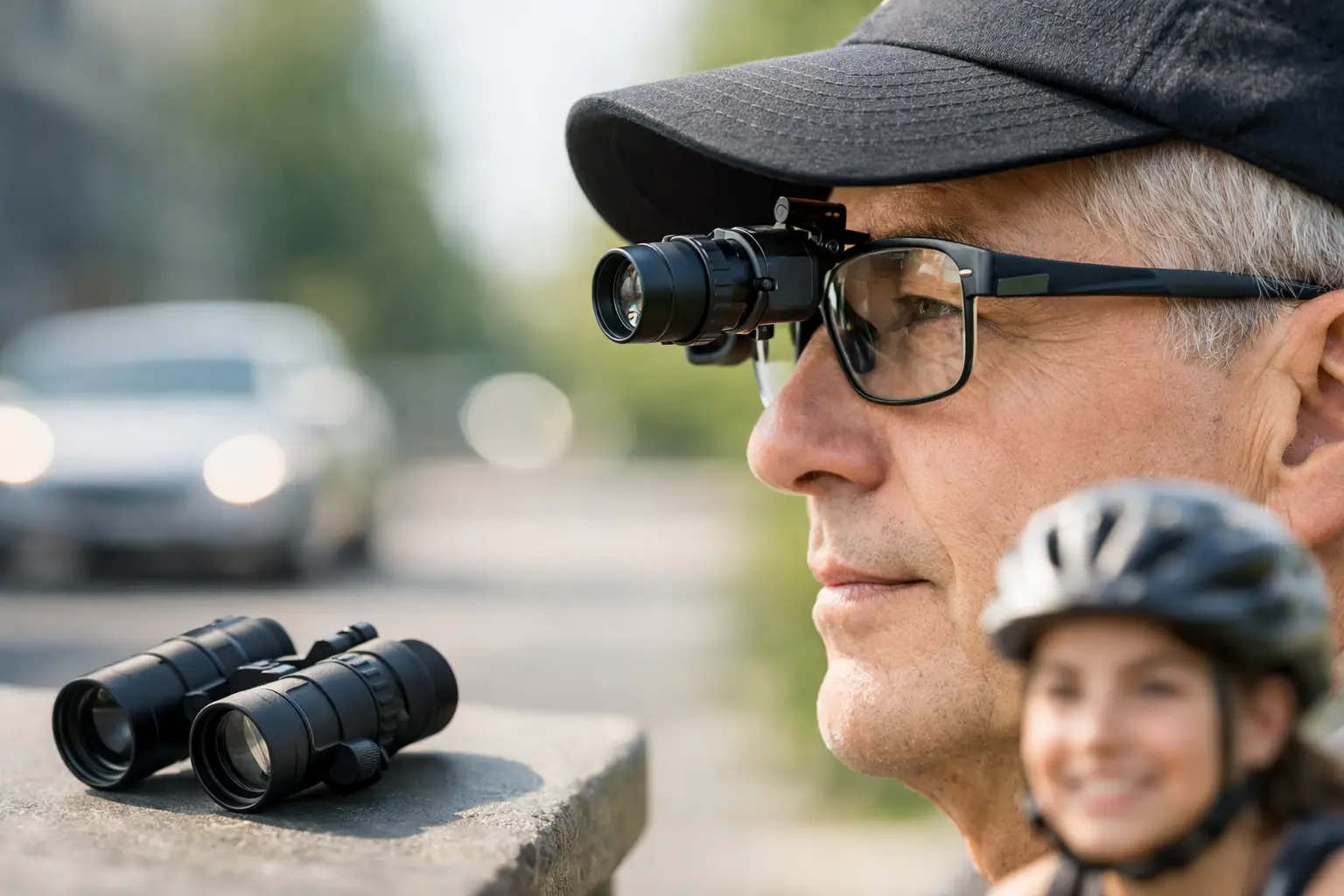
Bioptic telescopes are specialized low-vision devices built into prescription eyeglasses. They combine standard corrective lenses with small telescopes positioned near the top of the frame. The wearer looks through the regular prescription lens for normal day-to-day vision, then briefly tips their eyes up to use the telescope when a distant detail needs to be clearer.
They are not a cure for low vision, and they are not the same as magnifying reading glasses. A bioptic system is designed to make distant objects appear larger, helping selected patients use their remaining vision more effectively.
What Are Bioptic Telescopes?
A bioptic telescope is a compact telescopic lens mounted on a pair of glasses. Most systems are focused for distance and may magnify an image about two to six times, depending on the patient’s needs and the device selected. A road sign, whiteboard, television screen, speaker at an event, or a person across a room may become easier to see when viewed through the telescope.
The word “bioptic” refers to the way the device works with two viewing options. The carrier lens is the regular prescription portion of the glasses. The telescope sits above it, allowing the wearer to move naturally through the day using the larger, unobstructed prescription lenses. When detail is needed, they use a quick head or eye movement to look through the telescope.
That distinction matters. Bioptics are meant for brief, targeted viewing rather than constant use. Looking through a telescope narrows the field of view, so it is generally not the best way to walk through a crowded space, go down stairs, or scan a wide area. The ordinary prescription lens remains the primary lens for mobility and general vision.
How a Bioptic System Is Fitted
A successful bioptic is more than a telescope attached to a frame. It requires a detailed low-vision assessment. The eye doctor measures visual acuity, contrast sensitivity, prescription needs, eye health, visual fields, and the specific tasks that are difficult for the patient.
The device must then be selected and positioned precisely. Telescope power, focus, lens prescription, frame fit, height, and spacing all affect how useful and comfortable the final glasses will be. A system that is even slightly misaligned can be frustrating to use.
Training is also part of the process. New wearers need time to learn when to use the telescope, how to locate a target efficiently, and how to switch between the regular lens and telescope without losing their place. The adjustment period varies. Some people become comfortable quickly; others need several follow-up visits and practice with real-life tasks.
Who May Benefit From Bioptic Telescopes?
Bioptic telescopes are commonly considered for people with reduced distance vision that cannot be fully corrected with standard glasses, contact lenses, medication, or surgery. They can be helpful for people with stable low vision caused by conditions such as macular degeneration, optic nerve disease, albinism, congenital eye conditions, diabetic retinal changes, or reduced vision after an eye injury.
The diagnosis alone does not determine whether bioptics will help. Two people with the same condition may have very different visual abilities, goals, and tolerance for magnification. The strongest candidates are often people who have a clear reason to see detail at a distance and enough usable vision to benefit from magnification.
For one person, that may mean following a presentation at work. For another, it may mean seeing a grandchild perform on stage, reading departure boards, recognizing faces, watching television, or independently locating signs in the community. Children and teens may use bioptics to see the board at school or participate more comfortably in activities where distant detail matters.
Bioptics can support independence, but expectations should stay realistic. They cannot restore normal vision or reverse the underlying eye condition. A person may see a sign more clearly through the telescope and still have difficulty with glare, low contrast, peripheral awareness, or changing light conditions.
Bioptics and Driving
Driving is one reason people ask about bioptic telescopes, but it is also the area where careful evaluation matters most. In some jurisdictions, people with low vision may be permitted to drive using a bioptic telescope if they meet specific visual requirements, complete required training, and satisfy licensing rules. In other cases, driving with a bioptic may not be permitted or may involve additional restrictions.
A bioptic is not a shortcut to driving eligibility. Safe driving depends on much more than reading a distant sign. It involves visual acuity, peripheral field, contrast sensitivity, glare recovery, reaction time, eye health, driving experience, and the ability to scan the road safely through the regular carrier lenses.
When driving is a goal, an eye doctor can assess whether further evaluation is appropriate and explain the relevant local requirements. A qualified driving rehabilitation professional may also be part of the process. Patients should never assume that buying or wearing a bioptic telescope makes them licensed or safe to drive.
The Benefits and Limits to Understand
The most meaningful benefit of a bioptic telescope is access to detail that standard correction cannot provide. Rather than moving physically closer to every sign, screen, or face, the wearer has a tool available for quick spotting. For many people with low vision, that can make school, work, social activities, and community errands feel more manageable.
There are trade-offs. Magnification reduces the amount of area visible through the telescope. Higher magnification can make an object easier to see, but it also narrows the view and can make locating the object more difficult. The best choice is usually not the strongest telescope. It is the one that provides enough detail while remaining practical for the patient’s goals.
Appearance and comfort are practical considerations, too. Modern systems are smaller and lighter than many people expect, but they are still specialty eyewear. Frame choice, lens thickness, weight, and cosmetics can influence whether a patient feels confident wearing them. Cost and insurance coverage may also vary, since bioptics are customized medical optical devices.
Not every patient will benefit from a telescope. Significant visual field loss, double vision that cannot be controlled, severe light sensitivity, poor contrast sensitivity, or difficulty using the device safely may limit its value. In some situations, other low-vision options such as filters, electronic magnifiers, specialized lighting, handheld devices, or accessibility settings may better match the patient’s needs.
What to Expect at a Low-Vision Evaluation
A low-vision evaluation starts with a conversation about what is difficult and what matters most. “I cannot see well” is a useful starting point, but examples lead to better recommendations. Trouble reading labels, seeing the board, identifying people, checking a bus number, or viewing a television screen each points to different visual demands.
The doctor will review your eye history and current prescription, perform targeted testing, and look at the health of your eyes. You may try different magnification levels or device styles during the visit. The goal is not simply to find something that makes letters appear bigger. It is to determine whether a device helps you complete a meaningful task comfortably and safely.
If a bioptic is recommended, fitting and follow-up care are essential. The first pair may need adjustment as you learn to use it in daily life. Bringing real examples of your challenges to follow-up visits can help refine the device and your training.
Low vision does not mean that useful vision is gone. For the right patient, a carefully prescribed bioptic telescope can turn distant details from a daily barrier into a task with a workable solution. A low-vision assessment at Mountain Eye Care can help determine whether bioptics, another specialty device, or a combination of options best supports the activities you want to keep doing.