A concussion can leave someone feeling “almost better” while schoolwork, computer use, driving, or a busy grocery store still feels unexpectedly difficult. A neurovisual assessment for concussion looks beyond a standard eye chart to identify whether the visual system is contributing to those lingering symptoms. For many patients, that missing piece explains why headaches, dizziness, eye strain, or trouble focusing continue after the initial injury.
Vision is not simply about seeing clearly at a distance. The eyes, brain, balance system, and attention work together constantly. A concussion can disrupt that coordination, even when the eyes themselves are healthy and a routine vision screening appears normal.
Why concussion symptoms often show up visually
After a concussion, the brain may have difficulty processing visual information efficiently. This can make everyday demands feel overwhelming: reading a paragraph, tracking a moving object, shifting focus from a phone to the room, or walking through a visually busy environment. Symptoms are often worse when the person is tired, under stress, or trying to return too quickly to full work or school demands.
Common vision-related symptoms include headaches with reading or screen use, blurred or double vision, light sensitivity, motion sensitivity, nausea in visually busy places, difficulty concentrating, losing one’s place while reading, and fatigue that seems out of proportion to the task. Children may avoid homework, become frustrated with reading, or report that words move on the page. Adults may notice reduced productivity, difficulty driving at night, or discomfort moving between meetings, screens, and close work.
These symptoms do not automatically mean there is a neurovisual disorder. Dry eye, an uncorrected prescription, migraine, medication effects, vestibular conditions, and other health concerns can also affect comfort and visual performance. That is why a thorough evaluation matters.
What a neurovisual assessment for concussion evaluates
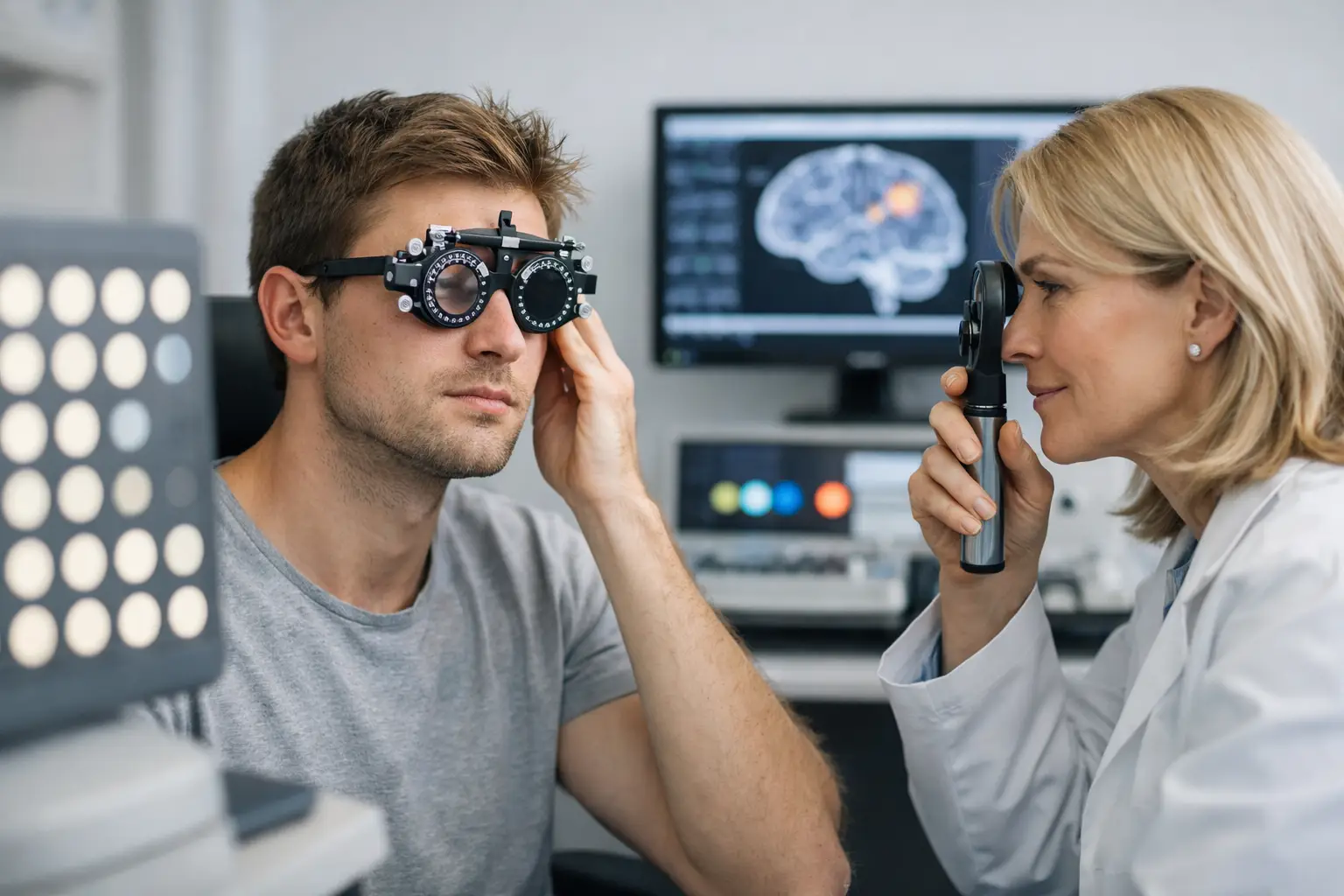
A neurovisual assessment is designed to examine how the visual system performs under real-world demands, not just whether a person can identify letters on a chart. The exact testing depends on the patient’s symptoms, injury history, age, and current level of function.
An optometrist may begin by discussing the injury, the onset and pattern of symptoms, previous vision needs, and the activities that now feel difficult. Knowing whether symptoms occur while reading, playing sports, using screens, or walking through stores helps focus the examination.
Eye coordination and convergence
The eyes must point together accurately to create one clear image. Convergence is the ability to turn both eyes inward for close work such as reading or using a phone. After concussion, some patients develop convergence insufficiency or another eye coordination issue. This can cause headaches, double vision, words appearing to shift, and early fatigue during near tasks.
Focusing ability
Accommodation is the system that changes focus between far and near distances. A person may see clearly across the room but struggle to keep print clear at reading distance or to refocus after looking up from a screen. Testing can reveal whether focusing is slow, inaccurate, or difficult to sustain.
Eye movements and visual tracking
Efficient reading relies on precise eye movements. The eyes must jump from word to word, hold their place on a line, and follow moving targets when needed. Assessing pursuits, saccades, and fixation can help identify patterns that may contribute to skipped lines, reduced reading speed, motion sensitivity, or discomfort during sports and daily activities.
Visual processing and visual fields
Some patients report that crowded environments, movement, or peripheral activity are difficult to tolerate. Depending on the clinical picture, testing may evaluate visual attention, processing demands, peripheral awareness, and visual field concerns. Advanced diagnostic tools can also be appropriate when the doctor needs to assess ocular health or rule out eye-related causes of symptoms.
A normal eye exam can still miss the problem
A standard comprehensive eye exam remains an essential part of eye health care. It can detect prescription changes, eye disease, retinal concerns, and other conditions that need attention. However, a patient can have 20/20 vision and healthy-looking eyes while still having difficulty with eye teaming, focusing, tracking, or visual motion after a concussion.
That distinction is meaningful. Clear eyesight answers one question. Comfortable, coordinated visual performance answers another. A neurovisual evaluation is particularly useful when symptoms persist despite a normal screening, or when visual tasks reliably trigger symptoms.
When to schedule an evaluation
Seek prompt medical care after a head injury, especially for worsening headache, repeated vomiting, increasing confusion, fainting, seizure, weakness, slurred speech, unequal pupils, new loss of vision, or unusual behavior. Those symptoms require urgent assessment and should not wait for an eye appointment.
For non-emergency concerns, a neurovisual evaluation may be appropriate when symptoms continue beyond the early recovery period, interfere with returning to school or work, or recur every time visual demands increase. It may also help when a patient has been told they are medically cleared but does not feel able to resume normal activities comfortably.
Timing depends on the situation. Some patients benefit from early assessment and practical visual accommodations, while others are referred when symptoms persist. The goal is not to push through severe symptoms or to assume every difficulty is visual. It is to identify treatable factors and coordinate care with the broader concussion recovery plan.
What happens after testing
The most useful outcome of an assessment is a clear, individualized plan. Sometimes the answer is a prescription update, temporary near-vision support, or a lens approach that improves comfort for a specific task. In other cases, the doctor may recommend a structured vision therapy program or refer the patient to another member of the concussion care team.
Recommendations may also include temporary adjustments to visual workload. Shorter reading intervals, planned breaks, larger print, reduced screen glare, or gradual return to visually demanding activity can make recovery more manageable. These strategies are not a substitute for treatment when a defined issue is present, but they can reduce unnecessary symptom flares while the patient recovers.
It is equally important to set realistic expectations. Recovery is not identical for every person, and progress may be gradual. The right plan depends on the findings, the severity and timing of symptoms, school or job requirements, and whether other systems, such as balance or migraine management, are involved.
Supporting children, students, and working adults
Concussion-related visual symptoms can be easy to misread. A child who avoids reading may appear unmotivated. A student who cannot complete timed work may seem distracted. An adult who loses focus during a video call may believe they are simply tired. When symptoms are triggered by specific visual demands, describing those patterns clearly can help the care team make better decisions.
Families and patients should track what brings symptoms on, how quickly they begin, and what helps. Useful details include whether the problem is worse with small print, fluorescent lighting, scrolling, motion, driving, or close work. Bringing glasses, contact lens information, previous prescriptions, and any concussion documentation to the appointment can also support a more complete evaluation.
At Mountain Eye Care, neurovisual care is approached as part of the patient’s overall visual health. The focus is on careful testing, clear explanations, and recommendations that fit the patient’s daily life – whether that means getting through a school day, returning to work, or feeling more comfortable in routine activities.
The value of finding the right cause
Persistent symptoms after a concussion deserve more than guesswork. Not every headache or reading problem comes from the visual system, but when eye coordination, focusing, or processing is involved, identifying it can change the path forward. A comprehensive neurovisual assessment provides practical information for patients, families, and other providers involved in recovery.
If visual tasks continue to trigger symptoms after a concussion, do not assume that discomfort is something to simply tolerate. A focused eye evaluation can help clarify what is happening and support a safer, more confident return to the activities that matter.