When a child’s glasses prescription becomes stronger year after year, families often search for orthokeratology versus myopia control as if they were two competing choices. They are not. Orthokeratology, often called Ortho-K, is one form of myopia control. The more useful question is whether it is the right form of treatment for your child’s eyes, routine, prescription, and long-term needs.
Myopia, or nearsightedness, makes distant objects look blurry. It is common in children, but it deserves more attention than simply updating glasses when the prescription changes. Higher levels of myopia can raise the lifetime risk of certain eye conditions, including retinal problems, glaucoma, and myopic macular degeneration. Myopia control aims to slow how quickly the eye becomes more nearsighted while still providing clear, comfortable vision today.
Orthokeratology Versus Myopia Control: The Key Difference
Myopia control is a treatment goal. It includes several evidence-based approaches intended to slow myopia progression in children and teens. Orthokeratology is one treatment option within that larger category.
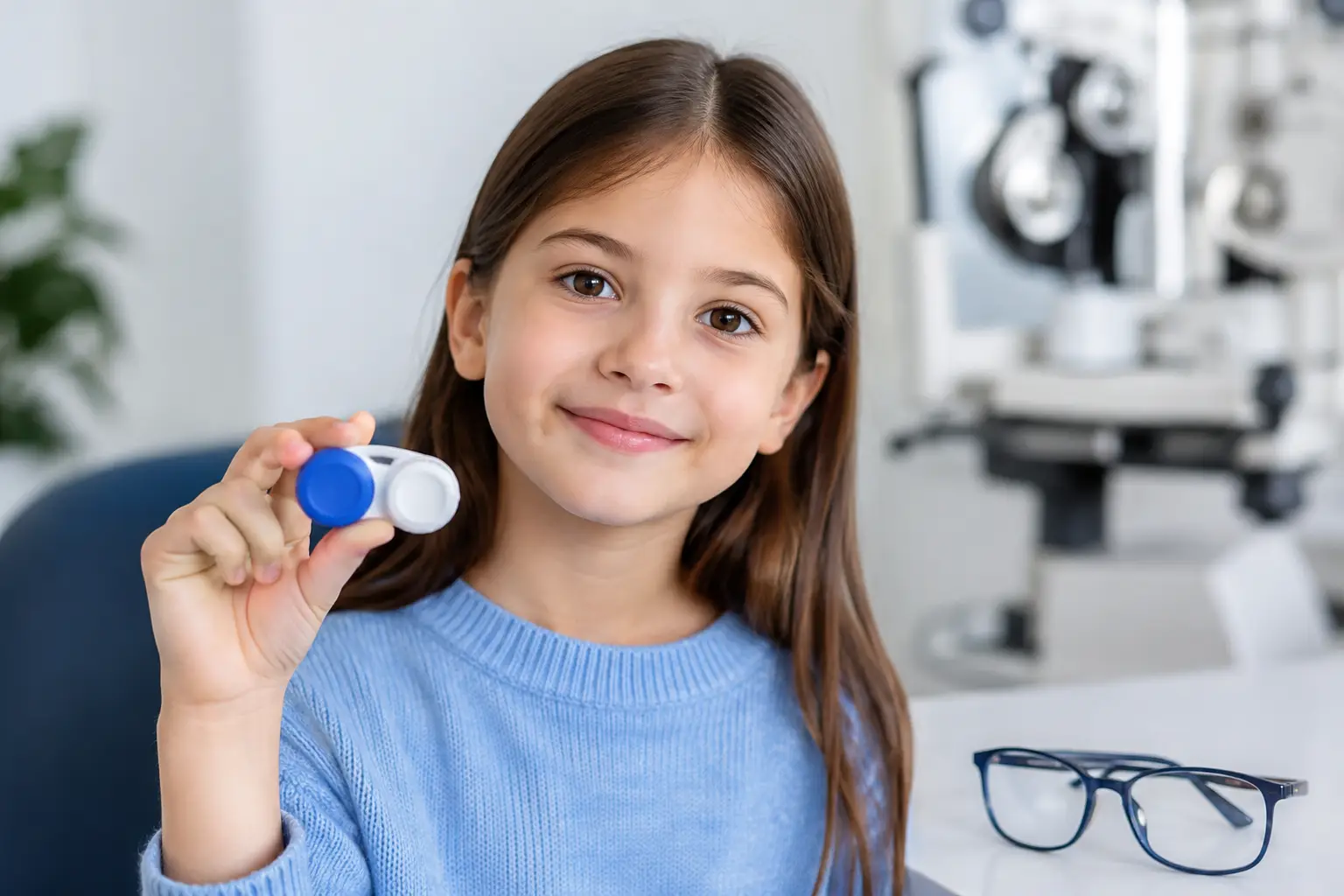
Ortho-K uses custom-designed rigid gas-permeable contact lenses worn overnight. While a child sleeps, the lenses gently reshape the front surface of the eye. After the lenses are removed in the morning, many patients can see clearly during the day without glasses or daytime contact lenses. The effect is temporary, so the lenses need to be worn consistently to maintain clear vision.
The same lens design can also create a peripheral focus pattern that may help slow eye growth in appropriate patients. That is why Ortho-K is considered a myopia control option, not simply an alternative to glasses.
Other myopia control approaches may include specially designed soft contact lenses, myopia-control spectacle lenses, and prescription low-dose atropine eye drops. A comprehensive eye exam and myopia evaluation help determine which option is most appropriate.
Why Slowing Myopia Progression Matters
A child’s prescription is not just a number on a glasses prescription. In many children, myopia progresses because the eye grows longer from front to back. The greater that elongation, the stronger the nearsightedness can become.
No treatment can promise to stop progression completely. Genetics, age of onset, family history, visual habits, and time outdoors can all influence how myopia develops. However, slowing progression can still make a meaningful difference over the years when a child’s eyes are changing most quickly.
Children who become nearsighted at a young age often have more years for myopia to progress. That does not mean every young child needs the same treatment, but it does mean early monitoring matters. Regular measurements allow the doctor to look beyond “Can your child read the chart?” and assess whether the prescription is changing faster than expected.
How Ortho-K Works in Daily Life
For the right patient, Ortho-K can be especially appealing because vision correction happens overnight. A child may spend the school day, play sports, and participate in outdoor activities without daytime glasses or contact lenses.
The process begins with detailed measurements of the cornea, the clear front surface of the eye. The lenses are custom fit, and follow-up visits are necessary to confirm that the cornea is responding properly and that daytime vision is clear. The fitting is not a one-time purchase. It is an ongoing clinical treatment that requires monitoring.
Parents and children also need to be comfortable with the nightly routine. Lenses must be cleaned, disinfected, stored correctly, and replaced according to the doctor’s instructions. A responsible adult should supervise younger children until they consistently demonstrate safe lens handling.
Who may be a good candidate for Ortho-K?
Ortho-K may be a strong option for a child who is motivated, has a prescription within a treatable range, and wants freedom from daytime correction. It can be particularly practical for active children who play contact sports, dance, swim, or simply dislike wearing glasses during the day.
It is not automatically the best choice for every child. Some children are not ready for contact lens care. Others may have dry eye symptoms, eyelid concerns, corneal shape issues, or lifestyle factors that make another myopia control approach more suitable. A child who struggles to follow hygiene instructions may be safer and more successful with glasses or prescription drops.
Comparing Ortho-K With Other Myopia Control Options
The best treatment is not always the one with the most convenient marketing message. It is the one a child can use safely and consistently, with clear monitoring and realistic family expectations.
Specialty soft contact lenses
Soft myopia-control contact lenses are worn during the day and removed at night. They can be easier for some children to adapt to because they feel more like traditional soft contacts. They provide clear daytime vision and may be a good fit for families who prefer a daily disposable lens routine.
Compared with Ortho-K, soft lenses do not provide glasses-free daytime vision after removal. However, daily disposable options can reduce some cleaning responsibilities, which may be helpful for busy families or children who are still developing independent hygiene habits.
Myopia-control glasses
Specially designed spectacle lenses can slow myopia progression while offering the simplicity of glasses. They are often an excellent starting point for younger children, children who are not ready for contacts, or families who prefer the lowest-maintenance approach.
Glasses do need to be worn consistently, and they may be less convenient during certain sports. Still, they are noninvasive, easy to manage, and can be highly practical. A child does not need to touch their eyes, insert a lens, or complete a nightly cleaning routine.
Low-dose atropine eye drops
Prescription low-dose atropine drops are typically used at bedtime. They do not correct vision during the day, so a child will still need glasses or contact lenses for clear sight. Their role is to help slow progression rather than replace vision correction.
For some patients, drops are a useful standalone option. For others, they may be considered alongside optical treatment when progression remains a concern. The appropriate concentration, expected effects, and follow-up plan should be discussed with an eye doctor who is monitoring the child’s myopia carefully.
Safety and Follow-Up Are Part of the Treatment
Contact lens-related infections are uncommon when lenses are used properly, but they can be serious. Overnight lens wear requires careful hygiene and prompt attention to warning signs. Pain, redness, light sensitivity, discharge, or reduced vision should never be ignored. A child should stop wearing lenses and contact their eye care provider promptly if these symptoms occur.
This is one reason a proper Ortho-K program includes more than lenses. It includes corneal measurements, fit assessments, progress checks, prescription monitoring, and clear instructions for handling any problems. Families should also bring lenses and lens cases to appointments when requested so the care routine can be reviewed.
At Mountain Eye Care, myopia management decisions are made with the child’s eye health, visual needs, and family routine in mind. Advanced testing and regular follow-up help turn a growing prescription into a plan rather than a recurring surprise at each annual exam.
Questions to Ask Before Choosing a Treatment
Before starting Ortho-K or another myopia control option, parents should understand what success looks like. Ask how progression will be measured, how often follow-up visits are needed, what costs should be expected over time, and what happens if the treatment is not controlling progression as hoped.
It is also helpful to discuss daily life honestly. Does your child reliably brush their teeth and follow routines? Are they comfortable touching their eyes? Do they play sports several days a week? Would nighttime drops be easier than contact lens care? The right answer is often practical, not theoretical.
A good plan can also change. A child may begin with myopia-control glasses and move into contact lenses later. Another may start with Ortho-K and need an adjustment if their prescription or lifestyle changes. Ongoing care allows treatment to remain responsive to the child rather than locked into one choice.
The most helpful next step is a dedicated myopia evaluation before the prescription climbs again. Clear vision matters now, but protecting a child’s future eye health is the reason myopia control deserves a closer look.