A child who keeps moving closer to the television, squints at the classroom board, or needs a stronger glasses prescription every year may be experiencing more than an inconvenience. Myopia, or nearsightedness, commonly develops in childhood and can progress as the eyes grow. Parents asking how to slow myopia progression are right to seek care early: reducing the speed of progression may help lower a child’s lifetime risk of serious eye disease associated with high myopia.
Myopia control is not about promising that a child will never need glasses. It is a personalized plan designed to manage eye growth, preserve clear day-to-day vision, and monitor long-term eye health.
Why myopia progression deserves attention
With myopia, distant objects look blurry because light focuses in front of the retina rather than directly on it. In most children, this happens because the eye grows longer from front to back. A stronger eyeglass prescription corrects the blur, but standard glasses alone do not necessarily address the underlying eye-growth signal.
A child’s prescription can change quickly, especially during the elementary and middle school years. The higher the final level of myopia, the greater the lifetime risk of conditions such as retinal tears or detachment, glaucoma, myopic macular degeneration, and cataracts. These outcomes are not inevitable, and a child with myopia can absolutely lead an active, healthy life. Still, managing progression is a practical investment in future eye health.
Family history matters. A child with one or two myopic parents has a higher likelihood of becoming myopic, but genetics are not the whole story. Near-work habits, limited time outdoors, age of onset, and the child’s rate of progression all help guide care.
How to slow myopia progression with a care plan
The right approach depends on your child’s age, prescription, eye health, daily routine, and ability to follow a treatment plan. An eye doctor may use one treatment or combine strategies over time. Regular exams are central because the plan should change if the prescription or eye growth changes.
Start with a complete eye exam and baseline measurements
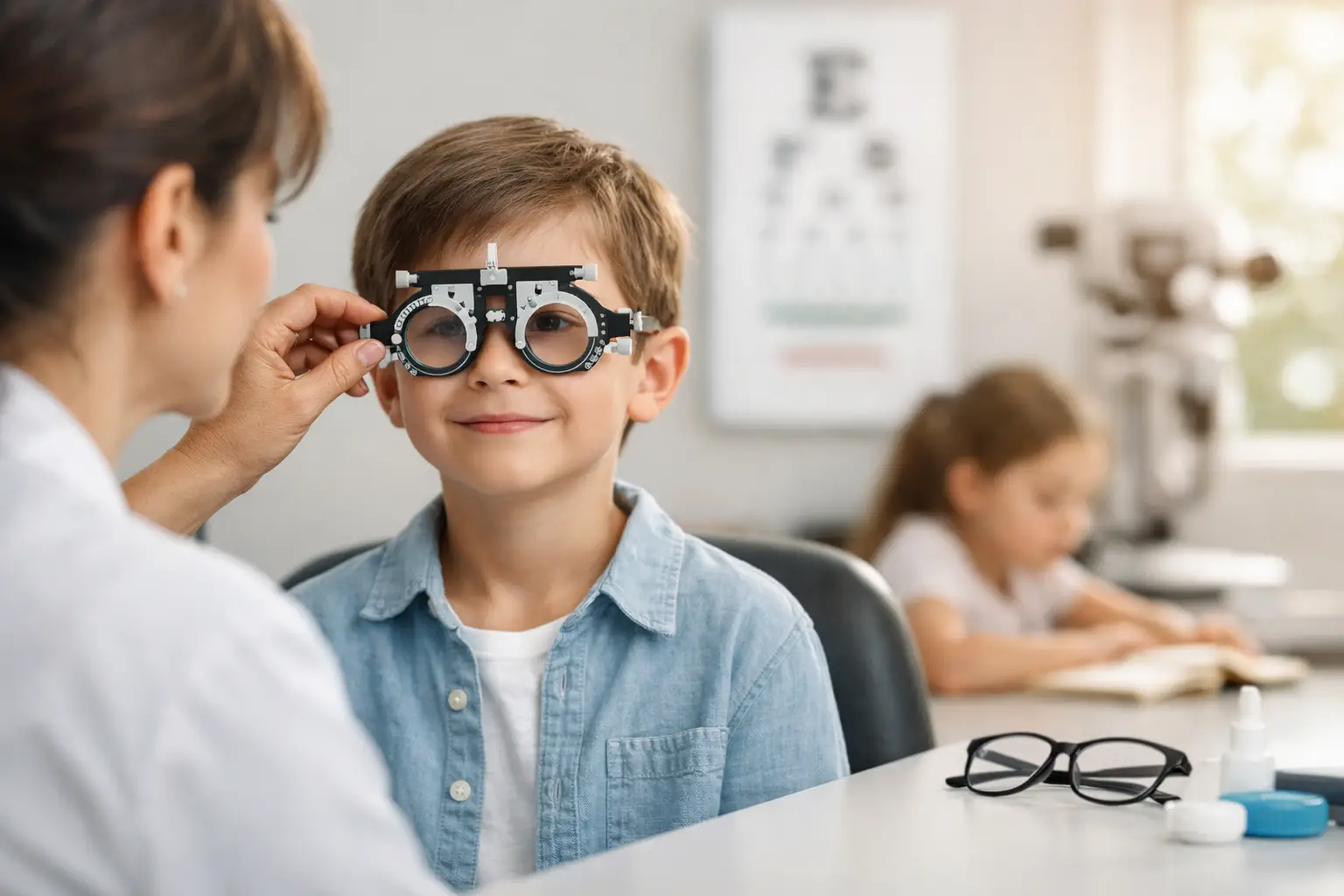
A comprehensive eye exam does more than determine whether your child needs new glasses. It checks eye health, evaluates how the eyes work together, and creates a reliable baseline for tracking change. Depending on the child and the clinic, measurements may include prescription after dilation, retinal imaging, and axial length, which is the length of the eye.
Axial length is particularly useful in myopia management because it measures the physical growth associated with myopia. A prescription may appear stable for a short period while the eye is still changing, so evaluating both clinical findings gives a clearer picture.
Follow-up timing is individualized. A child with newly diagnosed myopia or a rapidly changing prescription may need monitoring more often than a child whose measurements have remained stable.
Build more outdoor time into the week
Time outdoors is one of the simplest evidence-supported habits for children. Natural outdoor light and looking at distant objects appear to help reduce the likelihood of myopia onset and may support a broader control plan for children who are already nearsighted.
Aim for approximately two hours outdoors most days when practical. This does not have to mean organized sports. Walking the dog, biking, playing at a park, helping in the yard, or spending recess outside all count. Sun protection still matters, so use a hat and sunglasses with appropriate UV protection when conditions call for them.
Outdoor time is helpful, but it is not a replacement for clinical treatment in a child whose myopia is progressing quickly. Think of it as a healthy daily habit with real value, not a stand-alone cure.
Improve near-work habits without treating screens as the villain
Reading, homework, and screens do not automatically cause myopia. Children need these tools for school and connection. The goal is to avoid long, uninterrupted periods of close work and to create a more comfortable visual routine.
Encourage your child to hold books and devices at a reasonable working distance rather than inches from their face. Break up close work regularly by looking across the room or out a window for about 20 seconds. Good lighting, a comfortable posture, and scheduled breaks can reduce eyestrain and make these habits easier to maintain.
The details matter less than consistency. A family that takes brief visual breaks during homework and protects outdoor playtime will usually see more success than one trying to enforce rigid rules that do not fit real life.
Consider evidence-based myopia control treatments
Several treatment options can slow myopia progression in appropriate children. No single choice is best for every family.
Specialized soft contact lenses are worn during the day and use optical designs intended to influence peripheral focus while correcting vision. They can be a good option for children who are motivated to handle lenses responsibly and for families comfortable with daily lens hygiene. Contact lens wear requires consistent cleaning, replacement, and follow-up to reduce the risk of infection.
Orthokeratology lenses, often called ortho-k, are rigid lenses worn overnight. They temporarily reshape the front surface of the eye so a child can often see clearly during the day without glasses or contact lenses. Ortho-k can be appealing for sports and active routines, but it requires careful cleaning, correct wear, and close professional oversight because overnight lens wear carries additional risk.
Myopia-control eyeglass lenses use specialized optical zones to correct distance vision while managing peripheral defocus. They may be especially practical for younger children, children who are not ready for contacts, or families who prefer glasses as the primary option. Availability and design options can vary.
Low-dose atropine eye drops may be prescribed to slow progression for some children. Atropine treatment is not the same as a standard over-the-counter eye drop and should only be used under an eye doctor’s direction. The ideal concentration, possible side effects, duration, and access can vary, so families should have a clear discussion about expectations and monitoring.
These approaches can slow progression, but they do not permanently reverse myopia or guarantee that the prescription will stop changing. A treatment that works well for one child may be inconvenient or less effective for another. Comfort, adherence, cost, visual needs, and clinical response all deserve a place in the decision.
Signs your child may need a myopia evaluation
Do not wait for a school vision screening to be the only check on your child’s eyesight. Screenings can identify concerns, but they do not replace a full eye exam. Schedule an evaluation if your child squints to see far away, sits unusually close to screens, complains of headaches or tired eyes, loses their place while reading, or has difficulty seeing the board at school.
Children do not always recognize blurred distance vision as a problem because it may be all they remember. A parent may notice subtle changes first: less confidence in sports, declining interest in reading signs from a distance, or stronger prescriptions at frequent intervals.
What parents can do between appointments
The most useful role for parents is steady support. Make sure glasses are worn as prescribed, help children follow contact lens or drop instructions exactly, and share any concerns about comfort or vision changes promptly. Avoid buying unproven products that claim to stop myopia without a complete assessment and monitoring plan.
Keep a simple record of prescription changes and ask the eye doctor what measurements are being followed. Questions worth asking include whether your child’s progression is faster than expected, which treatment options fit their lifestyle, how success will be measured, and when the plan should be reassessed.
For families in Hamilton, Mountain Eye Care can evaluate a child’s vision and eye health, discuss appropriate myopia control options, and provide ongoing monitoring as their needs change. The best next step is a comprehensive eye exam before another school year or another prescription change passes by unnoticed.