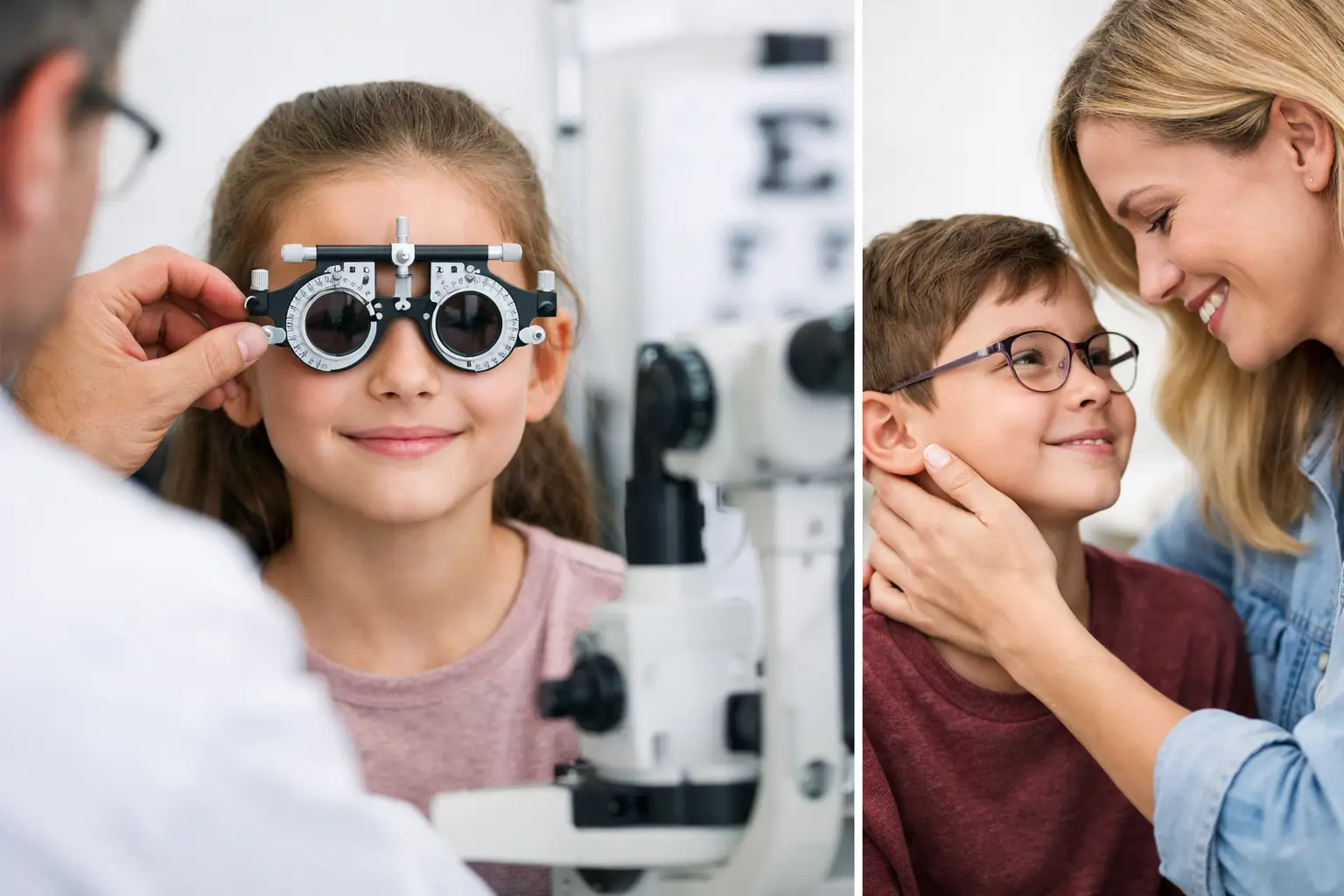
A child who starts holding books closer, squinting at the classroom board, or moving nearer to the TV may be showing more than a need for new glasses. Nearsightedness can progress during the school years, sometimes quickly. Myopia control for children is a proactive approach that aims to slow that progression while helping children see clearly now.
For parents, the goal is not simply to update a prescription each year. It is to understand how fast the prescription is changing, what may be driving it, and whether a treatment plan could help protect long-term eye health. A comprehensive pediatric eye exam is the right place to begin.
What myopia means for a child’s eyes
Myopia, commonly called nearsightedness, occurs when the eye grows too long from front to back or when the eye focuses light in front of the retina rather than directly on it. Nearby objects remain clear, while distance vision becomes blurry.
A stronger glasses prescription can correct the blur, but it does not necessarily slow the underlying eye growth. That distinction matters. Higher levels of myopia are associated with a greater lifetime risk of certain eye conditions, including retinal problems, glaucoma, cataracts, and myopic macular changes. Those risks do not mean a child with myopia will develop these conditions. They do mean that slowing progression when possible is a meaningful part of long-term care.
Myopia often begins in elementary school, though it can appear earlier or later. It commonly progresses while a child is growing, particularly through the teen years. Some children have a relatively stable prescription, while others change by a significant amount from one exam to the next.
Why a regular eye exam is more useful than a vision screening
A school vision screening can identify some children who may need follow-up care, but it is not a full eye examination. It may not measure the degree of myopia precisely, assess eye health, or identify factors that can affect a child’s visual development.
A comprehensive exam allows the doctor to evaluate prescription changes, eye alignment, focusing ability, and the overall health of the eyes. Depending on the child’s needs, measurements may also help monitor eye growth over time. This baseline is especially valuable when there is a family history of nearsightedness or when a child’s prescription is changing regularly.
Parents should schedule an exam sooner rather than later if a child squints, complains of headaches, avoids distance activities, loses their place when reading, or says the board at school is blurry. Children do not always recognize that their vision is different from what it should be. They may simply adapt by sitting closer or avoiding activities that are harder to see.
Who may benefit from myopia control for children?
Myopia control is often considered when a child has developing or progressing nearsightedness, particularly if the prescription has changed over a short period. A younger child with myopia may have more years of eye growth ahead, which can make early evaluation especially helpful.
Family history also matters. Children with one or two nearsighted parents have a higher likelihood of becoming nearsighted themselves. Time spent on close work, limited outdoor time, and individual eye-growth patterns can all play a role. However, myopia is not caused by one behavior alone, and parents should not feel blamed for a child’s prescription.
The best candidates are determined individually. Age, prescription, rate of progression, eye health, maturity, lifestyle, sports participation, and the family’s ability to follow a treatment routine all shape the recommendation. A treatment that works well for a responsible teen who is comfortable with contact lenses may not be the right starting point for a younger child.
Treatment options for childhood myopia
There is no single best method for every child. Evidence-based myopia management may include specialty contact lenses, orthokeratology, low-dose atropine eye drops, or a combination of approaches. The purpose is to reduce the rate of progression, not promise that myopia will stop completely.
Specialty soft contact lenses
Certain daily-wear soft contact lenses are designed with optical zones that can help slow myopia progression while providing clear vision during the day. For many families, daily disposable lenses are appealing because a fresh lens is used each morning and discarded at night.
Contact lenses require good hygiene and consistent handling. Children who wear them must be mature enough to follow instructions, wash and dry their hands, and report discomfort promptly. With proper fitting, education, and follow-up, contact lenses can be a practical option for many school-age children.
Orthokeratology lenses
Orthokeratology, often called Ortho-K, uses specially fitted rigid contact lenses worn overnight. The lenses temporarily reshape the front surface of the eye, allowing some children to see clearly during the day without glasses or daytime contacts.
This option can be particularly convenient for active children, but it requires careful nightly wear, cleaning, and scheduled monitoring. Because lenses are worn during sleep, families must be committed to the care routine and follow all instructions closely. It is not a casual or one-size-fits-all solution.
Low-dose atropine drops
Low-dose atropine eye drops may be prescribed to help slow myopia progression in some children. The drops are typically used at bedtime and can be an option for children who are not ready for contact lenses or who need another strategy alongside vision correction.
The appropriate concentration, schedule, and follow-up plan should be determined by the child’s eye doctor. Some children may experience temporary side effects, such as light sensitivity or trouble with near focusing, depending on the formulation. These considerations are part of a thoughtful treatment discussion.
Glasses and specialty spectacle designs
Glasses remain essential for many children and are often the most straightforward way to provide clear, comfortable vision. Certain spectacle lens designs may also be considered as part of a myopia management plan. They can be a useful choice for children who prefer glasses or are not ready for contact lens care.
The right frame fit matters as much as the prescription. A child’s glasses should sit comfortably, stay in position during normal activity, and provide a clear field of view. A proper fitting helps encourage consistent wear, which is especially important at school and during activities that require distance vision.
Daily habits that support healthy visual development
Treatment works best as part of a broader plan. More time outdoors is associated with a lower likelihood of developing myopia in children, and outdoor play remains a practical, healthy habit for the whole family. It does not replace prescribed treatment, but it is a worthwhile part of prevention-focused care.
Parents can also encourage regular breaks during close work. A simple routine is to have children look away from books, tablets, or homework periodically and focus on something farther away. Good lighting, appropriate reading distance, and balanced screen habits can improve comfort, even though screen time alone does not explain every case of myopia.
Rather than focusing on perfect rules, aim for consistency: outdoor time most days, breaks during long periods of near work, and prompt attention when a child reports blur or eye strain.
Monitoring progress is part of the treatment
Myopia control is not a one-visit decision. Follow-up visits allow the doctor to check vision, prescription changes, eye health, lens fit when applicable, and how well the plan is working in real life. A child who has difficulty wearing lenses, experiences dryness, or is not following the routine needs a plan that can be adjusted, not judgment.
Some children will need a change in treatment as they grow. Others may continue with the same strategy for years. The frequency of follow-up depends on the child’s age, progression pattern, and chosen treatment, but ongoing monitoring is central to effective care.
At Mountain Eye Care, families can receive a clear assessment of their child’s vision, a discussion of appropriate management options, and continued support as their needs change. The most useful next step is often simple: schedule a comprehensive eye exam before another school year or prescription change passes by unnoticed.
Clear vision helps a child participate fully in class, sports, friendships, and everyday life. Addressing myopia early gives families more time, more options, and a better foundation for protecting growing eyes.